Size GuideEco ImpactContact Us

Process · 11 min read

How an IBC tote is actually reconditioned

Six stations, eleven gallons of water and one human nose. A walk down the wash line, written for people who want to know what happened to the container they just bought.

September 18, 2026 · Ibrahim Danso · ToteOrbit, Indianapolis

Questions on this article?

Reply within 1 business day

Send them straight to the author's bench. We answer operator questions whether or not there is an order attached.

US or Canada only — 10 digits, e.g. (317) 204-0100
US ZIP like 46226, or Canadian postal code like M5V 2T6
Whole units, 1 to 100,000

Fields marked * are required. Phone and postal code are checked against real US and Canadian number ranges, so please enter details we can actually reach you on.

Reconditioning an intermediate bulk container is not a car wash. It is a sequence of six deliberate operations, each of which exists because skipping it caused a problem once, and the order matters as much as the chemistry. Here is the whole thing.

Before the line: the part that is not washing

A tote does not come off the truck and go into a tank. The first thing that happens is that somebody reads its paperwork. Every inbound load carries a written prior-cargo declaration from the generator, and nothing moves off the trailer until that declaration has been read and logged against the units it covers.

This sounds bureaucratic. It is the single most important operation in the building. Prior cargo determines whether a unit can be washed at all, which chemistry it needs, how long it soaks, whether it can ever hold food again, and whether it is a reconditioning candidate or a rebottling candidate. Get it wrong and you contaminate a wash tank, a rack of other people's totes, and your own reputation in one afternoon.

We learned this in 2010 from twelve totes described verbally as “just soap.” They held a cationic surfactant blend that pitted the gaskets and left an odour no cycle would lift. All twelve went to resin recovery. Since then the rule has been absolute: no written declaration, no purchase.

Station one: pre-rinse

Ninety seconds of high-volume, low-pressure ambient water. The goal here is not cleaning, it is mass removal. Every pound of residue carried off at station one is a pound that does not consume caustic at station two, and caustic consumption is the largest variable cost on the line.

The effluent goes straight into the settling tank at the head of our water reclaim skid, where it sits for roughly twelve hours and drops its solids by gravity. Nothing from station one is wasted; it becomes the input to stage one of the skid.

Station two: caustic soak

Sodium hydroxide solution in a jacketed tank, held between 130 and 150 °F. The concentration is set by cargo class and the dwell time is the dial we actually turn: four minutes for a water-based agricultural chemistry, six for food syrups, eight for detergents, twelve for latex and adhesives, fourteen plus rework for anything that has begun to cure.

Every batch is logged — concentration, temperature, start time, operator initials. That log is not for us. It is what becomes the wash record that ships with your order, and it is the document your auditor will ask for.

Station three: internal agitation

This is the station that separates a real wash line from a determined person with a pressure washer. A rotating spray head drops through the six-inch dome port and drives a fan jet against the bottle wall through a full rotation, top dome to bottom corners.

A static fill-and-drain soak never properly reaches the lower corners or the underside of the dome. Those are exactly the places residue collects, and exactly the places a buyer will later find it. If you are building your own line and you can only afford one sophisticated station, build this one.

Station four: hot rinse, in two passes

First pass uses reclaimed water from the carbon-polish stage of the skid. Second pass is a fresh-water polish, roughly a gallon and a half, which guarantees the final surface the cargo will touch has seen clean water.

Splitting the rinse this way is the design decision that lets us hold an 86 per cent reclaim rate without compromising the finish. Most lines run a single rinse and therefore have to choose between water economy and surface quality. You do not have to choose; you have to plumb it differently.

Station five: dry

An air knife across the port, then dwell time on the rack — eight minutes in July, twenty in February. Residual moisture inside a sealed HDPE bottle is how mould and odour begin, and it is the most common fault in units washed by people in a hurry.

We would rather hold a rack an extra ten minutes than ship a damp tote. This is the least glamorous station and the one that generates the fewest complaints precisely because we are patient with it.

Station six: the human nose

Somebody opens the lid and smells it.

There is no instrument on the market that beats a trained nose for detecting fixed odour in HDPE at the concentrations that matter commercially. Gas chromatography will find compounds a nose misses, and it will also flag things nobody downstream would ever notice, at a cost per unit that makes no sense for a container. So a person smells it, and if it smells of anything other than warm plastic it does not go out as a cargo container.

After the sniff check the unit goes to the grading bench for nineteen inspection points and a written card, then to the test cell for a leak test and — if it is eligible — a new UN marking. Those stages have their own pages: grading and testing and certification.

What a wash cannot fix

Four things, and it is worth knowing them because they determine whether washing your units is money well spent or money wasted:

  • Odour fixation. Terpenes, flavour compounds and some surfactants dissolve into the polymer itself. The compound is now part of the wall. No cycle removes it.
  • Interior crazing. Fine surface cracking from solvent attack. It propagates under stress and it is a critical grading failure.
  • Stress whitening. The chalky patches at the lower corners are permanent mechanical damage to the polymer structure.
  • Cross-threaded ports. Mechanical, not chemical, and one of the few faults that can condemn an otherwise perfect bottle.

If your units have any of those, washing them is spending money on a container that still needs rebottling. We will tell you that before we take the job, not after.

The number people ask about

Eleven gallons of water per cycle, of which about 86 per cent is reclaimed, plus the thermal energy to hold the caustic at temperature. Total wash burden works out at roughly nineteen pounds of CO₂e per unit, which we subtract from the 259 pound new-tote baseline before publishing a savings figure of 240.

Against the alternative — moulding a new bottle, fabricating and galvanising a new cage, and trucking the result from a factory — it is not a close contest. The full derivation is on Carbon Math, including the exclusions.
REFERENCE

Reference

The tables behind this article

Every dimension, thread, seat material and cargo rating referenced above, in full. The complete versions live in the size guide.
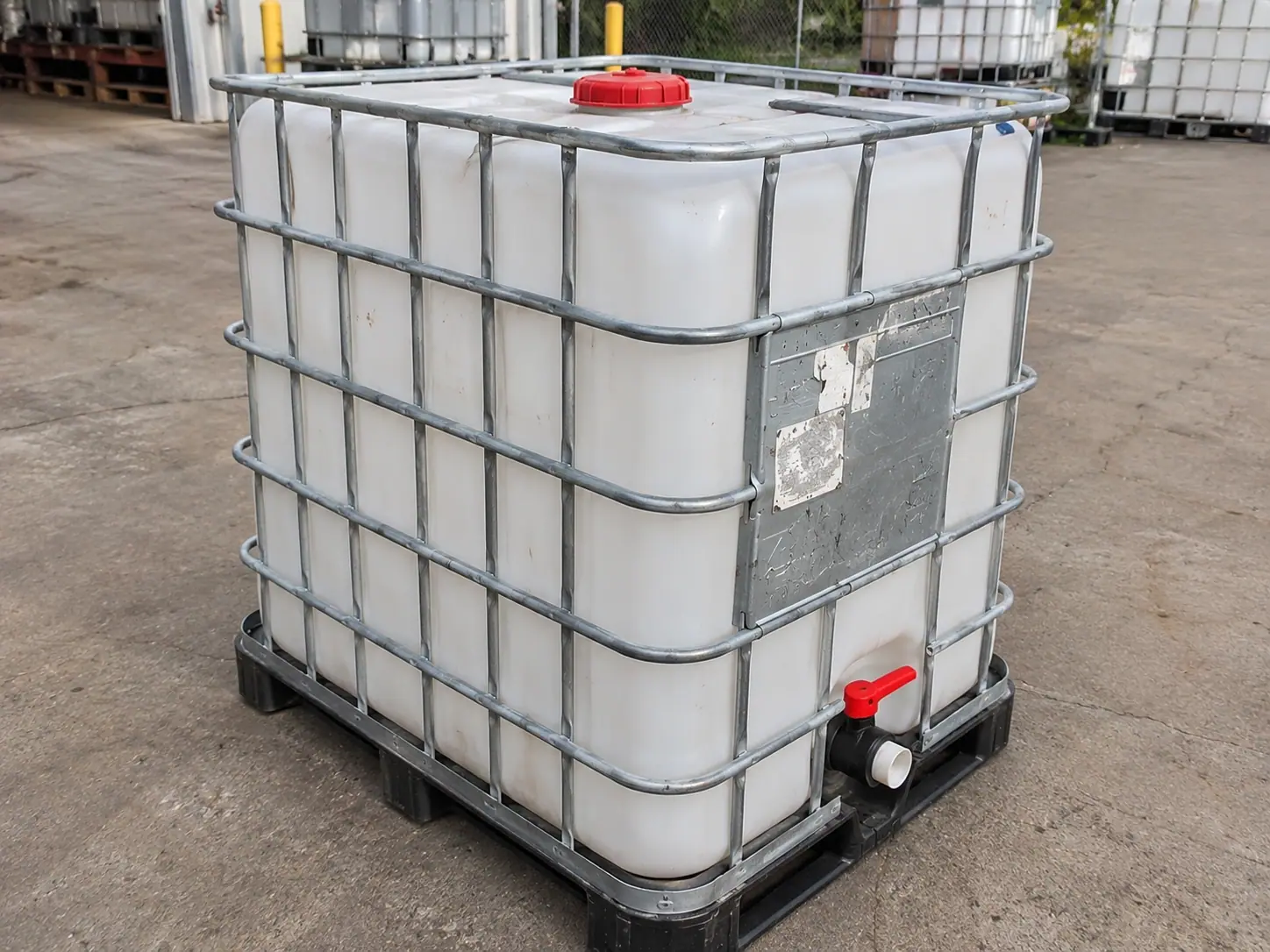
A reconditioned 275 gallon caged composite IBC tote on a black plastic pallet, showing the galvanised cage, the moulded HDPE bottle, the red discharge valve and the six-inch fill capFig. 1
A single 275 gallon unit off the outbound pad. Galvanised tubular cage, blow-moulded HDPE bottle, 2 in S60x6 outlet, six-inch vented fill cap.
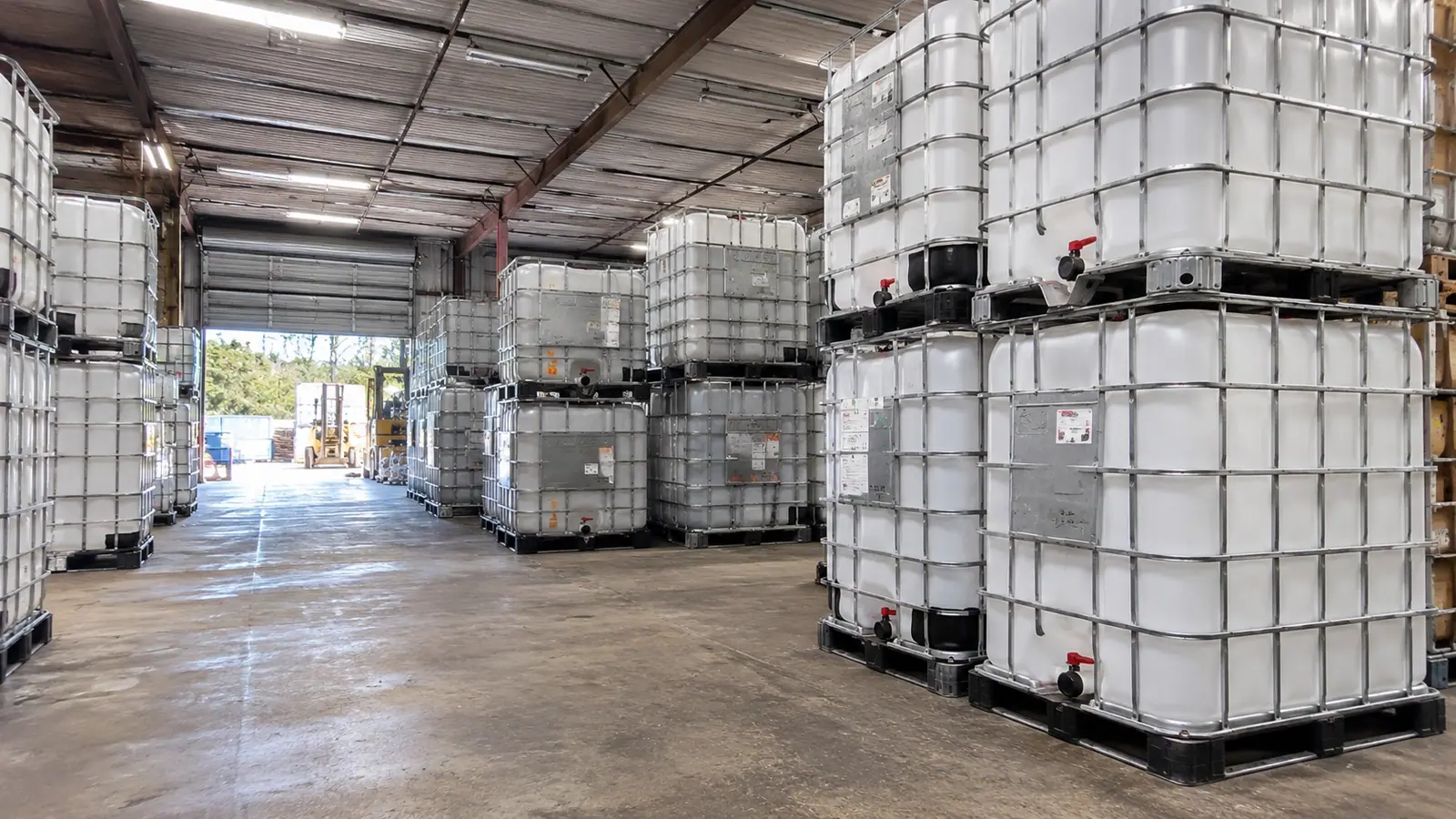
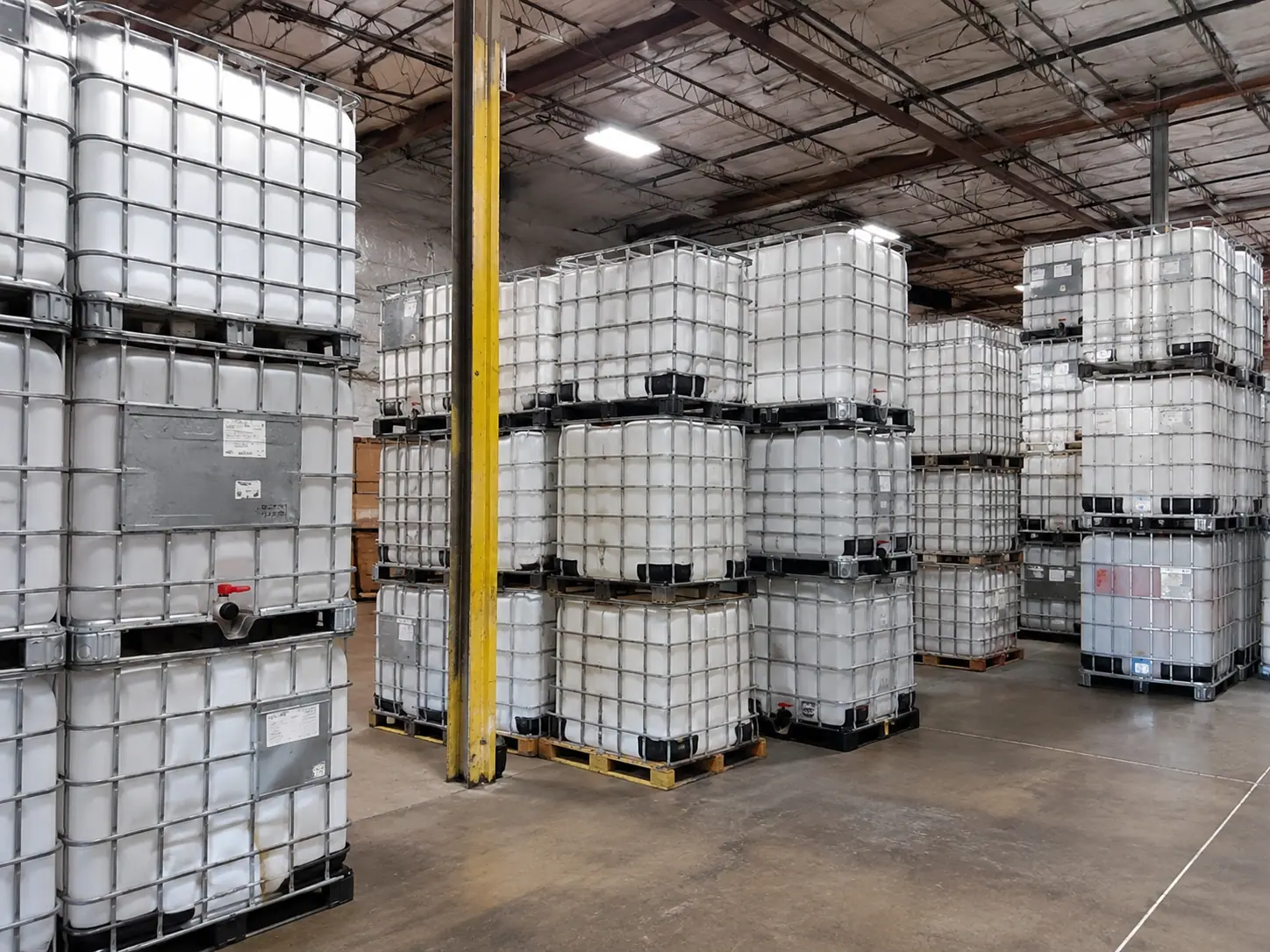
Rows of IBC totes stacked two and three high on pallets inside the Indianapolis warehouseFig. 2
Graded stock under roof, staged two and three high. Loaded units never stack more than two, and never while warm.
Nominal figures. Gross weight assumes water at 8.34 lb/gal — multiply by your cargo's specific gravity, then check it against the maximum permitted gross mass on the unit's own marking.
CapacityLitresFootprintHeightTareGross (water)Stack loaded
275 gal1,04148 × 40 in46 in≈140 lb≈2,435 lb2 high
330 gal1,24948 × 40 in53 in≈155 lb≈2,905 lb2 high
350 gal1,32548 × 40 in56 in≈165 lb≈3,075 lb2 high
120 gal45440 × 32 in38 in≈95 lb≈1,095 lb2 high
180 gal68142 × 36 in42 in≈115 lb≈1,616 lb2 high
550 gal2,08260 × 48 in60 in≈240 lb≈4,830 lb1 high

B / FITTINGS

What threads onto it

Fittings, threads and seat materials

S60x6 is a buttress thread that seals against a flat gasket face, not on the thread flanks. It is not interchangeable with NPT — forcing one into the other is the commonest hidden fault in used containers.
FittingSizeSeals bySeat optionsTypical service
S60x6 butterfly valve2 inFlat gasket faceEPDM, Viton, PTFEThe standard IBC outlet
S70x6 butterfly valve2 inFlat gasket faceEPDM, VitonEuropean and some 330 gal units
2 in NPT ball valve, poly2 inThread flanks + tapeEPDM, VitonRetrofits, metered dispensing
2 in NPT ball valve, stainless2 inThread flanks + tapePTFESolvents, pressure, hot cargo
3 in butterfly valve3 inFlat gasket faceEPDM, VitonViscous cargo, high flow
6 in fill cap6 inGasketed lidEPDM, siliconeVented or solid — choose deliberately
Camlock adapter, type C1.5 / 2 inCam arms + gasketBuna, VitonRepeated connect / disconnect
Bulkhead tap3/4 inBoth-side gasketsBrass, polyRain kits, site water
The valve body rarely fails. The seat does, and it is chosen by cargo rather than by price. Always verify against your specific concentration and temperature.
MaterialGood withAvoid withTemperatureCost
EPDMWater, acids, caustics, brine, ag-chemOils, fuels, aromatics-40 to 250 °FLow
Viton (FKM)Solvents, oils, fuels, aromaticsKetones, amines, hot steam-15 to 400 °FHigh
Nitrile (NBR)Oils, diesel, greases, hydraulicsOzone, strong oxidisers-30 to 250 °FLow
PTFE envelopeAlmost all chemistry, high purityNeeds very flat flange faces-100 to 450 °FHigh
SiliconeFood contact, wide temperatureSolvents, abrasion-60 to 450 °FMedium

C / COMPATIBILITY

Will HDPE hold it?

Sixteen cargo families, rated

HDPE is brilliant at most things and hopeless at a few. Where the answer is C, we will point you at stainless rather than sell you a container that will craze.
A = suitable, B = suitable with limits, C = not recommended in a composite IBC. Guidance only — verify against your own concentration and temperature.
Cargo familyHDPESeatNotes
Water, potable and non-potableAEPDM / siliconeFood-history units for potable
Acids and caustics, aqueousAEPDM / PTFEVent fuming cargo
Liquid fertiliser, UAN, NPKAEPDMSG up to 1.32 — check your lift-gate
Brine and chloride de-icerAEPDMHard on galvanising, kind to HDPE
Food syrups, oils, concentratesASilicone / VitonDocumented food history only
GlycolsAEPDMVery common; SG 1.04–1.11
AlcoholsAViton / PTFEFlammable — bond and vent
Diesel and gas oilBViton / NBRPermeates slowly over long storage
Mineral spiritsBVitonSwells HDPE slowly
Surfactants and detergentsBEPDMOdour fixation risk — dedicate units
Latex, adhesives, water-based paintAEPDMCures if left. Wash promptly.
Ketones, aromatics, chlorinated solventsC—Crazes HDPE. Stainless only.
Gasoline and low-conductivity fuelsC—Static risk. Steel or stainless.
Essential oils, flavour concentratesC—Fixes into the wall permanently. Never.
Hydrogen peroxide above 10%C—Decomposition and pressure risk
Dairy and hot-fill above 140 °FC—Needs CIP and steam. Stainless.

Permeation

Small non-polar molecules pass slowly through HDPE rather than attacking it. The bottle looks perfect and your cargo quietly leaves. It is a storage-duration problem: diesel for a week is fine, diesel for a year is not.

Crazing

Ketones, aromatics and chlorinated solvents cause fine surface cracking that propagates under stress. It is invisible until you hold the wall against a raking light, and it is a critical grading failure.

Odour fixation

Terpenes and some surfactants dissolve into the polymer itself rather than sitting on the surface. No wash removes them. This is why a food-grade tote has to have been a food tote from new.

A wide aisle inside the warehouse with IBC totes stacked on both sides and a roller door open at the far end
Compatibility decides where a container can go next. Everything in this aisle carries a written cargo history.

E / GRADING

A grade is a promise, not a mood

How every unit is scored

We publish the whole system because a grade without written criteria is just an opinion with a price tag. Nineteen points, fixed thresholds, one card per unit, seven years on file.
Every unit is scored against all nineteen. A single critical failure condemns the unit regardless of how the other eighteen score.
#PointCritical?
01Prior cargo declaration — present, written, specificYes
02Residual liquid — any volume at allYes
03Odour after wash — fixed odour by trained noseYes
04Bottle corner stress whiteningNo
05Interior scoring you can feelNo
06Interior crazing — fine surface crackingYes
07Bottle bulge or deformationYes
08Wall thickness at the thinnest pointYes
09Dome port condition and flange flatnessNo
10Outlet threads — cross-threading, chippingYes if crossed
11Valve function, full open and closeNo, replaceable
12Gasket condition — compression set, bloomNo, replaceable
13Cage squareness along the top railNo, pressable
14Cage weld integrity at tube intersectionsYes
15Cage coating and galvanising lossNo
16Pallet condition — cracked feet, rot, corrosionNo, replaceable
17Forklift pocket integrityNo
18UN marking legibility and dateNo, re-markable
19Leak test under our procedureYes

D / ORDERING

Commercial terms, up front

Lead times, minimums and what happens when it goes wrong

Discovering these at invoice stage is nobody's idea of a good relationship, so they are published.
Published so nothing arrives as a surprise at invoice stage. Prices themselves move weekly with resin, scrap steel and freight, which is why we do not publish a list.
ItemDetail
Minimum orderOne unit. No account minimum, no membership.
Stock lead timeGrade A and B 275 gal usually ship the same week
Rebottled lead time2–3 weeks, built to order in bay D
Food-grade lead time1–3 weeks when stock exists; supply-dependent
Full truckload45 on a 48 ft flat, 48 in a 53 ft van, 90 empties double-stacked
Payment, first orderPrepay by ACH or card
Payment, establishedNet 30 on credit approval
Grade guaranteeRegrade or replace, our freight both ways, 14 days
Leak warranty30 days from delivery, normal atmospheric service
CancellationFree until the truck is loaded
Returns14 days on unused stock units, freight at your cost
Sales taxIndiana resale certificates and out-of-state equivalents accepted

F / END OF LIFE

Reuse first, recycle last

What happens when the container is finally finished

Every unit that arrives is assessed down this list, in this order. 99.4% of incoming mass avoided landfill in 2024, and reuse plus repair accounted for over three quarters of it.
Assessed in this order, per unit, every time. The granulator is the fourth choice, not the first. 2024 figures against 2,994,000 lb of inbound mass.
StepOutcomeShare of massCost to us
01Reuse as is — wash and redeploy63.9%11 gal of mostly reclaimed water
02Repair and reuse — valve, gasket, pallet, cage11.4%Parts and bench time
03Rebottle — new bottle, reclaimed steel9.6%A new bottle, two thirds of mass retained
04Upcycle — rain kits, grow beds, wash stations3.2%Fabrication time
05Material recovery — HDPE regrind, steel, wood11.3%Grinding, washing, drying energy
06Residual to licensed disposal0.6%Sludge, gasket rubber, fasteners, laminates
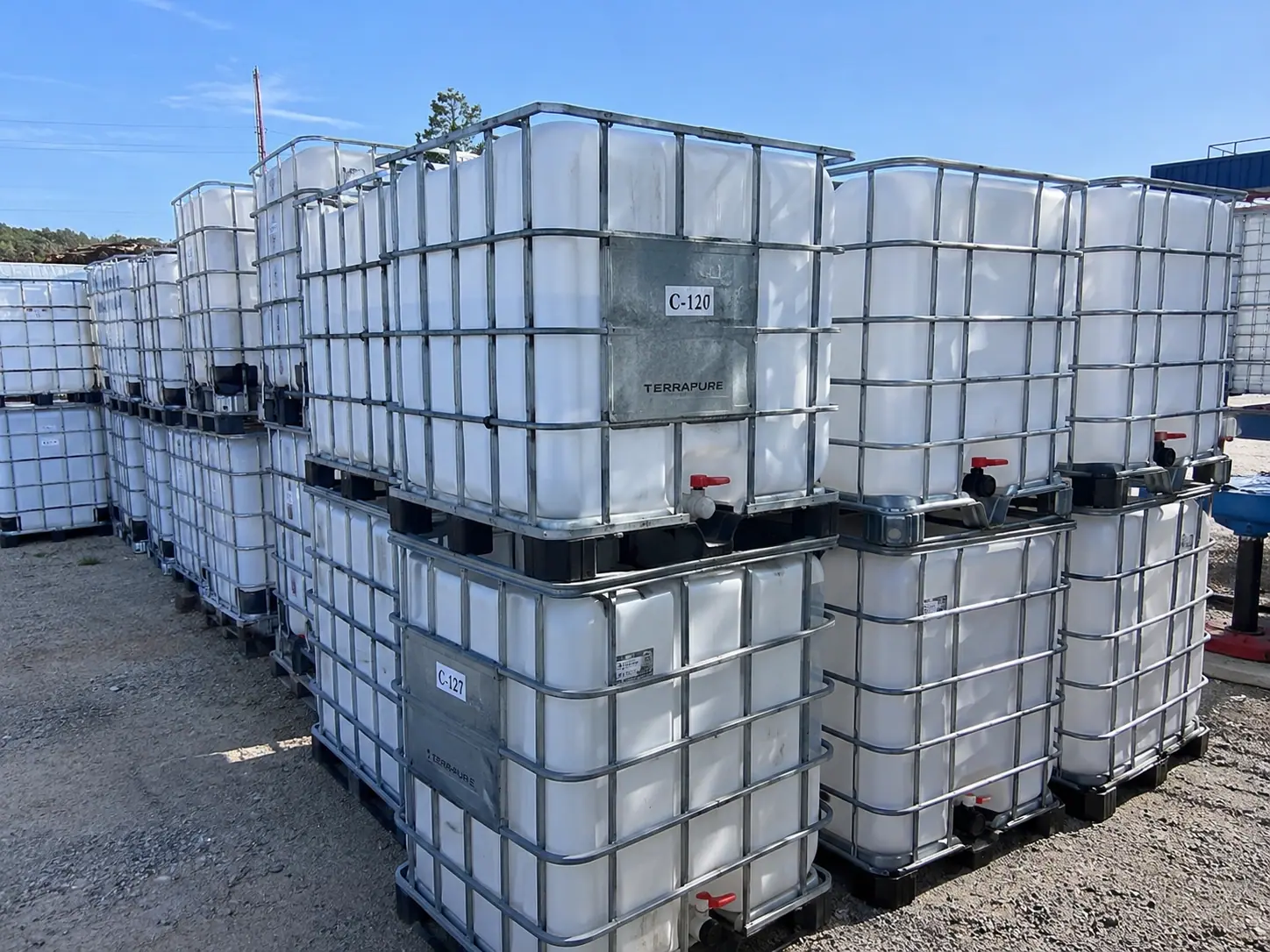
Stacks of used IBC totes under a clear blue sky on the gravel pad, awaiting grading
Inbound. Nothing comes off the trailer before its cargo declaration is read.
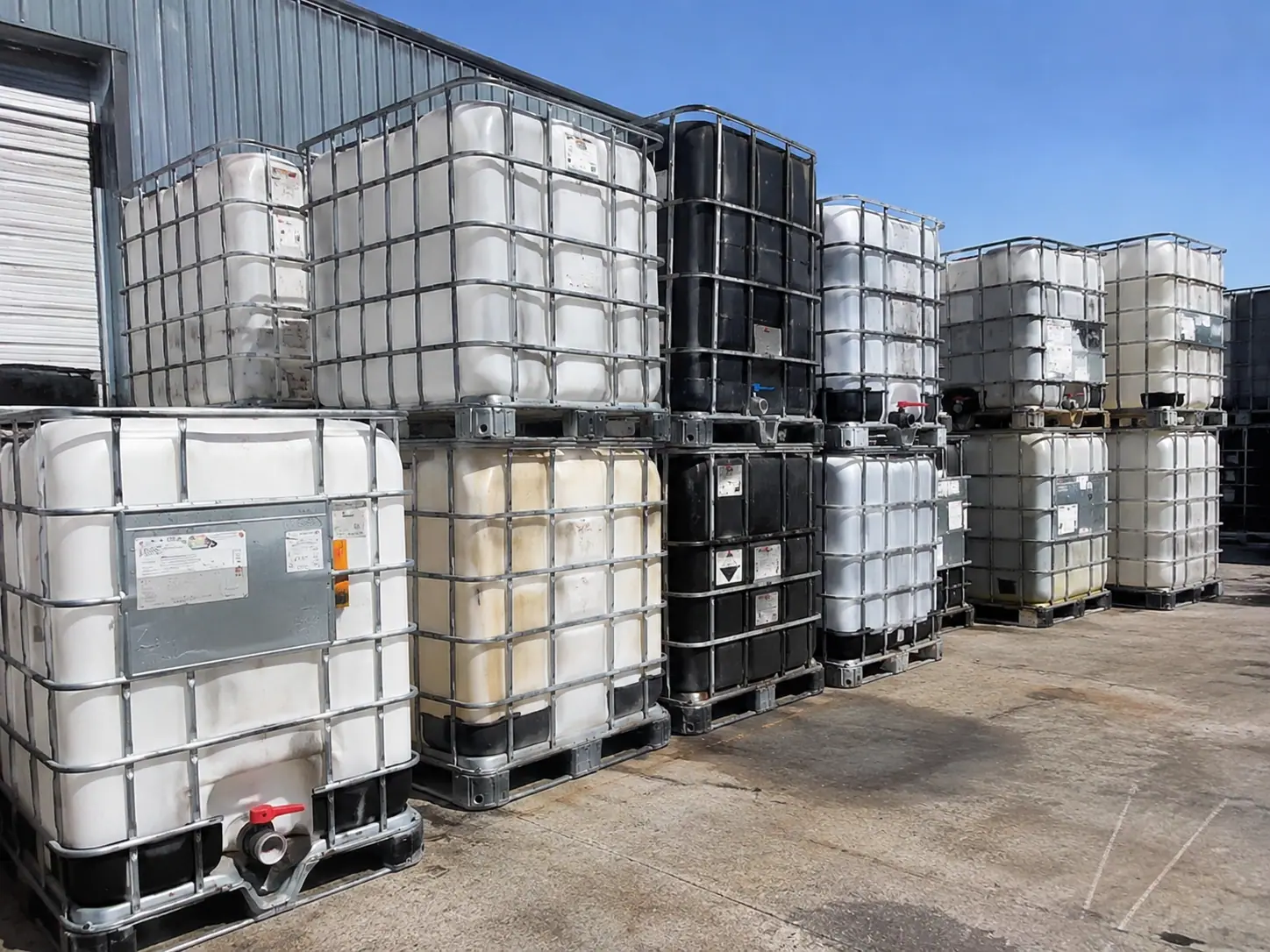
Mixed white and black IBC totes staged beside the loading dock doors
Graded and sorted. Black bottles are UV-stable units destined for outdoor service.
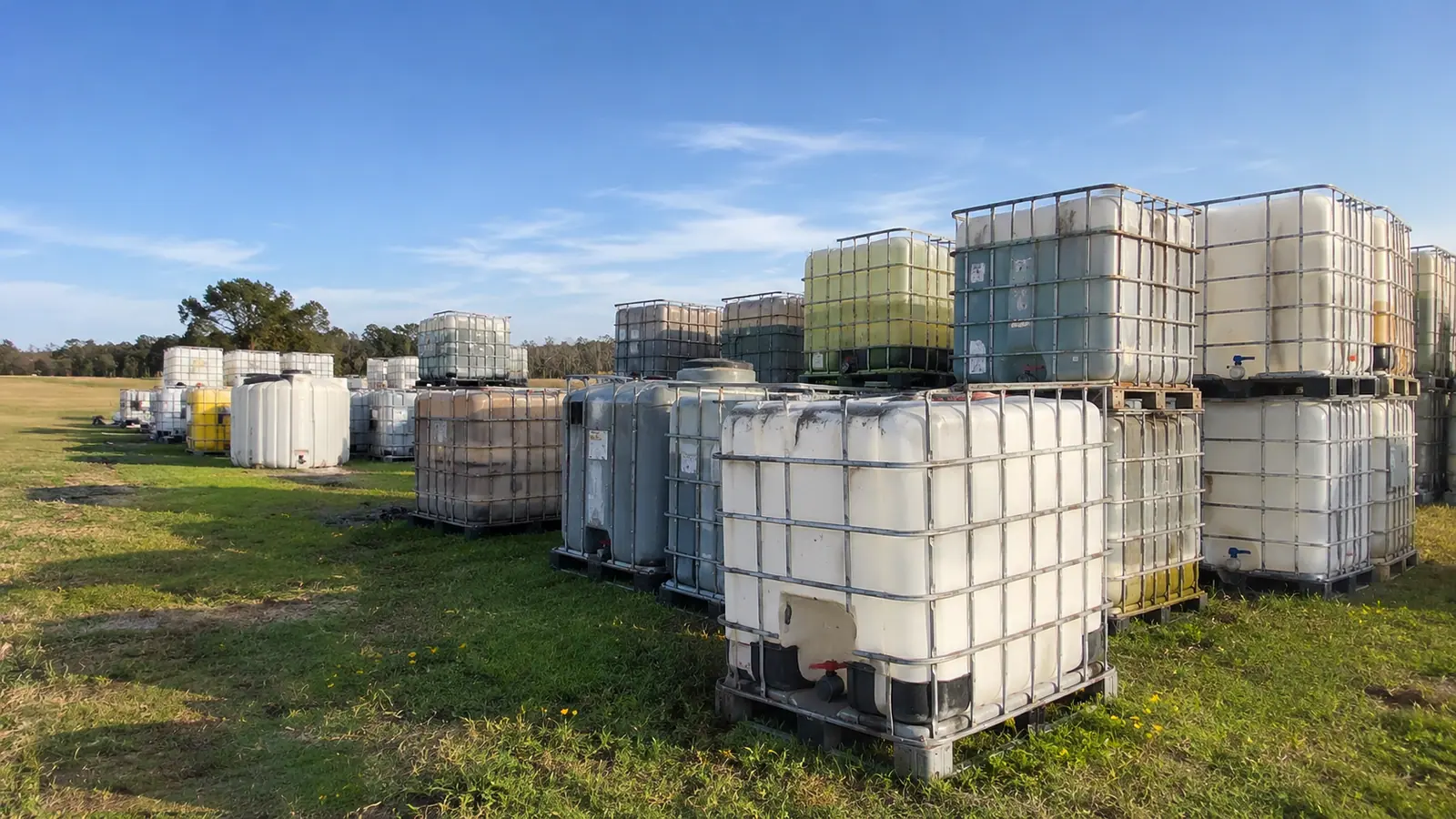
A wide field of IBC totes standing on grass under a blue sky, waiting to be collected
Recovered from a customer yard. Every one of these avoided a crusher.

From reading to ordering

Put what you just read to work.

Quantity, grade and ZIP in the form above gets you a delivered price tomorrow.
Use the form aboveContact details
Get a quote