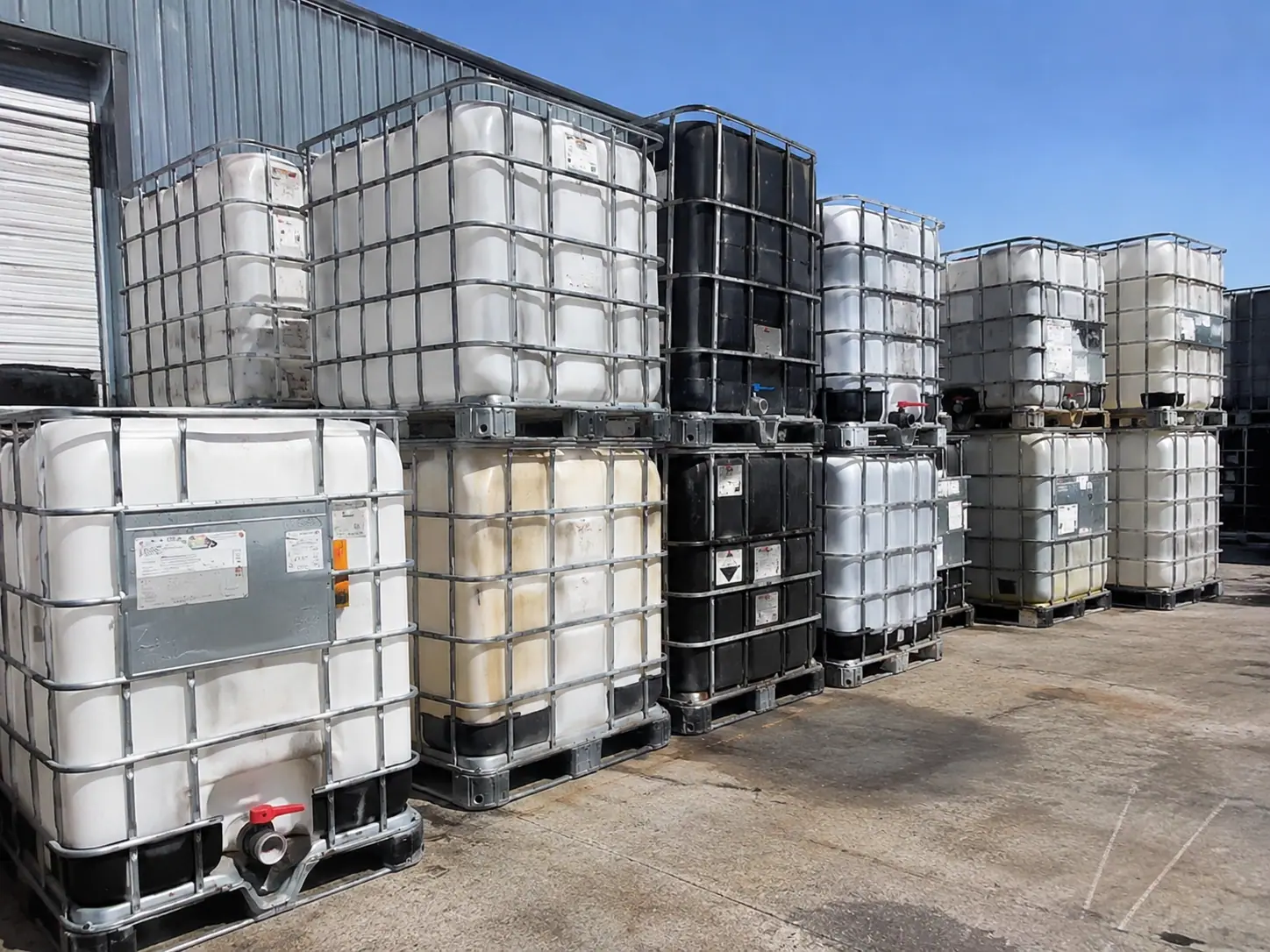
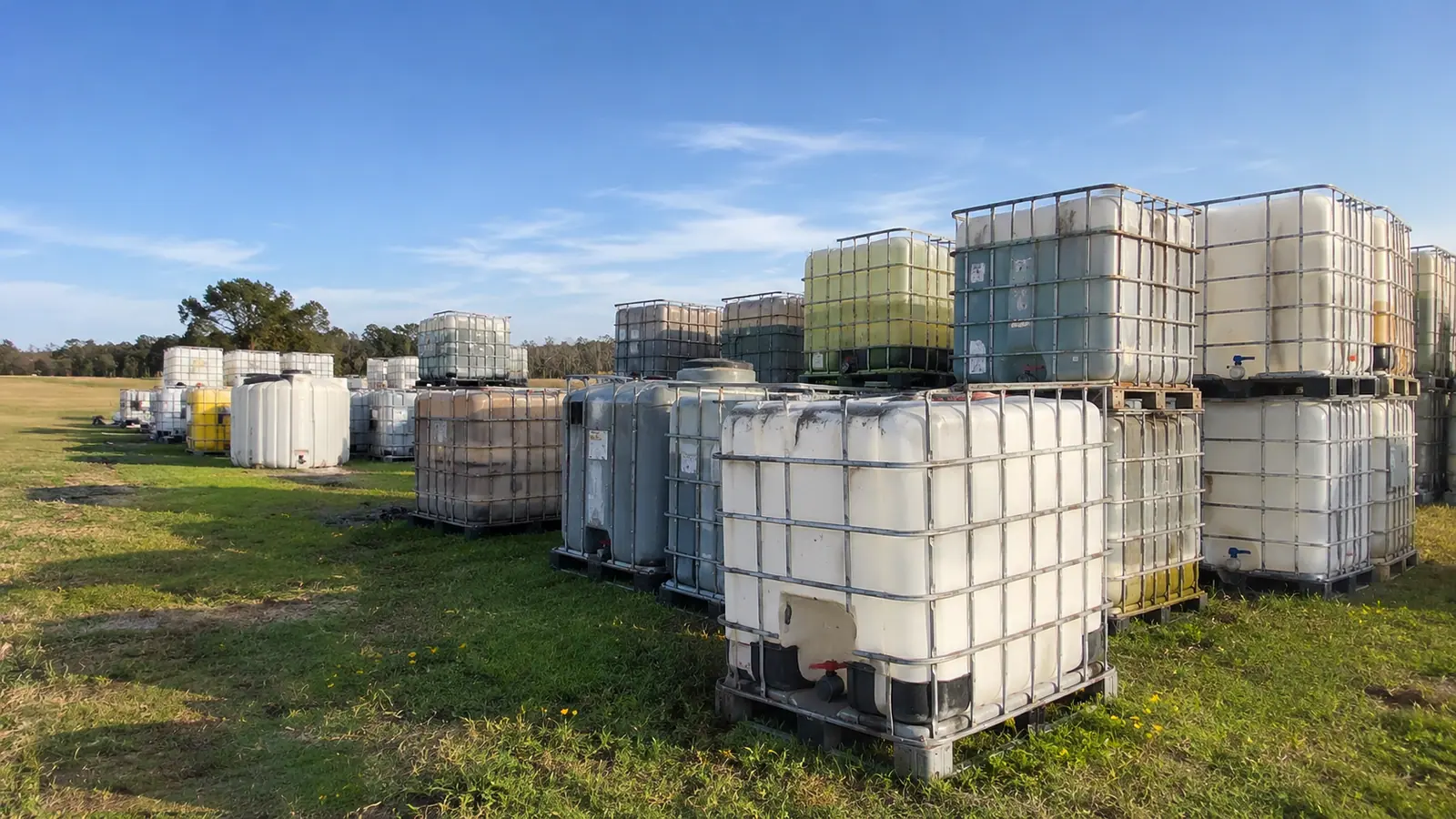
We sell new totes. Roughly one per cent of our volume. So publishing a detailed account of how much carbon a new tote carries is, commercially speaking, an odd thing to do. We did it anyway, because the alternative is making a vague claim about being green and hoping nobody asks.
Step one: weigh the thing
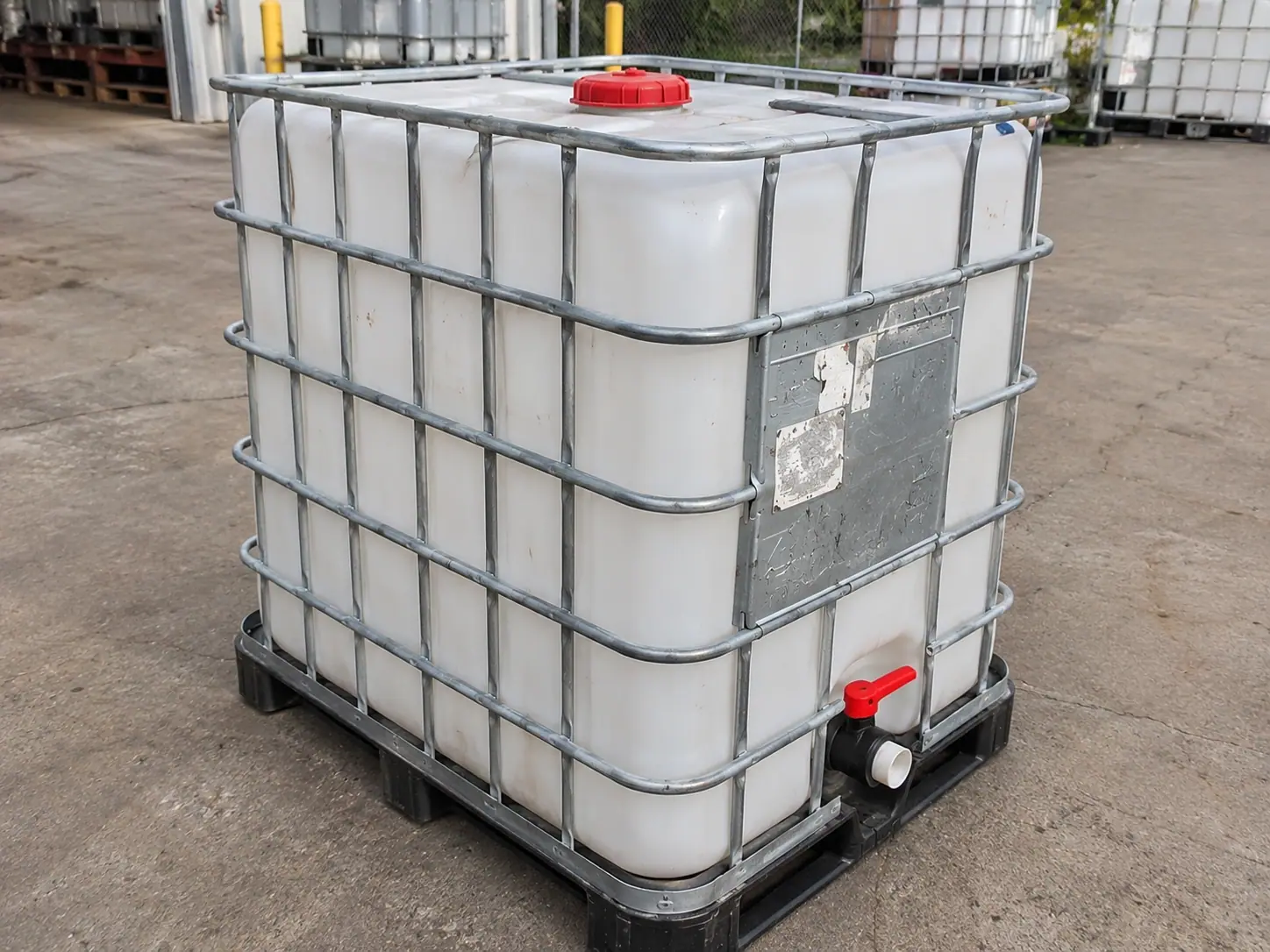
We weighed 240 new 275 gallon caged composite units from four different moulders, in composite-pallet configuration, and averaged the components.
| Component | Material | Mass | Share of tare |
|---|---|---|---|
| Bottle | Virgin HDPE | 40 lb | 28.6% |
| Cage | Galvanised tubular steel | 75 lb | 53.6% |
| Pallet | Composite | 22 lb | 15.7% |
| Valve, lid, gaskets | PP and EPDM | 3 lb | 2.1% |
| Total | — | 140 lb | 100% |
The first interesting result is in that table and it has nothing to do with carbon. Over half the mass of an IBC tote is steel cage. When people talk about tote sustainability they talk about plastic, because plastic is the culturally loaded material. But if you scrap a tote because the bottle is finished, you are throwing away 75 pounds of galvanised steel that was almost certainly fine. That realisation is why we started rebottling at volume in 2019.
Step two: apply manufacturing intensities
Cradle-to-gate carbon intensities for virgin HDPE in published literature run from about 1.8 to 2.6 kg CO₂e per kg. Galvanised steel tube runs 1.8 to 3.1. We used 1.9 for both — the low end of each range — on the principle that a company selling the saving should err against itself.
| Component | Mass (kg) | Intensity | CO₂e (kg) | CO₂e (lb) |
|---|---|---|---|---|
| Bottle | 18.1 | 1.9 | 34.4 | 76 |
| Cage | 34.0 | 1.9 | 64.6 | 142 |
| Pallet | 10.0 | 1.6 | 16.0 | 35 |
| Fittings | 1.4 | 1.9 | 2.7 | 6 |
| Total baseline | 63.5 | — | 117.7 | 259 |
Two hundred and fifty-nine pounds of CO₂e to put one empty container into existence. For context, that is roughly the same as burning thirteen gallons of gasoline, for an object that the industry routinely uses once.
Step three: subtract our own burden
Here is the part most reuse marketing skips. Reconditioning is not free. It uses water, thermal energy to hold caustic at temperature, electricity for pumps and air, caustic chemistry itself, and it generates a sludge that has to be dewatered and disposed of by a licensed handler.
| Input | CO₂e (lb) | Note |
|---|---|---|
| Fresh water | 0.1 | 1.5 gal — 86% of line draw is reclaimed |
| Thermal energy, caustic heating | 11.4 | Natural gas, metered per batch |
| Electricity, pumps and air | 4.6 | Indiana grid mix |
| Caustic chemistry | 2.1 | Consumption logged per batch |
| Sludge disposal | 0.6 | Dewatered, licensed handler |
| Total wash burden | 18.8 | Subtracted from the 259 baseline |
259 minus 19 is 240. That is where the number on the rest of this website comes from, and it is rounded down rather than up.
What we deliberately left out
Exclusions matter more than inclusions in any carbon claim, so here are ours. We excluded freight to the customer, because it depends entirely on your lane and including a national average would let us quietly help ourselves. We excluded freight of inbound empties, because it is usually paired with an outbound delivery and the marginal impact is small. We excluded any end-of-life credit for the avoided new unit, because that risks double counting and it would have made our figure look better.
We also excluded capital equipment amortisation and office energy, both of which are genuinely negligible spread across 180,000-plus units, and the carbon embodied in your cargo, which is not ours to count.
The uncomfortable arithmetic
Divide the 259 pound baseline by the number of trips a container makes:
| Trips | CO₂e per trip | Verdict |
|---|---|---|
| 1 | 259 lb | Indefensible |
| 2 | 130 lb | Still poor |
| 4 | 65 lb | Acceptable |
| 6 | 43 lb | Good — typical for our reconditioned stock |
| 9 | 29 lb | Excellent — pooled fleet territory |
Nothing about the container changes between those rows. No material is substituted, no process is improved, nothing is certified. The only variable is whether anybody is responsible for bringing it back — which is the argument for pooling in one line.
So when should you buy new?
When a written specification requires virgin resin. When you need a fitting or colour that does not exist in used stock. When the unit will be customer-facing and appearance is a commercial requirement. Or when you are starting a controlled pool from new units and intend to run them for a decade — which is genuinely one of the better environmental decisions available, despite starting with a new container.
What should not be on that list is “used feels risky.” We have had eleven leak failures out of roughly 180,000 units since 2015. The risk you would be paying 259 pounds of CO₂e to avoid is smaller than the risk posed by your own forklift.
Everything above, in table form with sources and the review cycle, is on Carbon Math. If you think a factor is wrong, tell us which one — two numbers on this site changed because a customer's engineer pushed back and was right.