Reconditioning & washing
Eleven gallons of water. Six stations. One very clean tote.
01 / THE LINE
Six stations
What each stage is for
Pre-rinse
Ambient flush. Carries off loose residue so the caustic does real work.
Caustic soak
Temperature-controlled, batch-logged, time set by prior cargo class.
Agitation
Rotating internal spray head, full 360° wall coverage.
Hot rinse
Reclaimed water, finished with a fresh-water polish pass.
Dry
Air knife plus dwell time. Residual moisture is how mould starts.
Grade & test
Nineteen points, leak test, re-mark where eligible.
02 / SERVICE TYPES
Three ways to use the line
Toll wash — you keep ownership
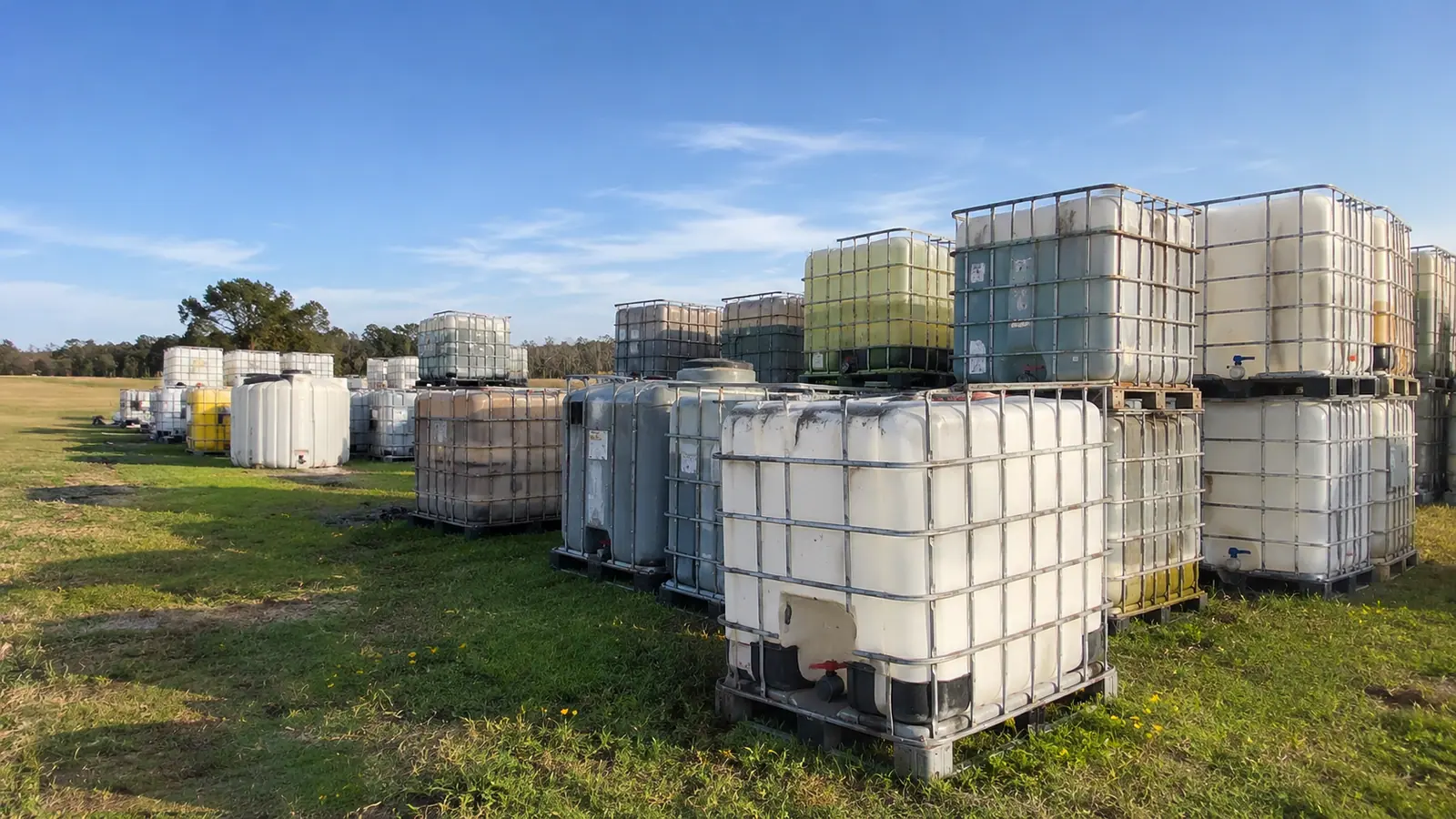
Your totes come to us, get cleaned and certified, and go back to you. Priced per unit with a per-load minimum. This is the right answer for any plant running a closed loop with its own customers, and it costs a fraction of building a wash bay and permitting the discharge.
Trade-in wash — you swap
You send dirty units and receive clean graded ones from stock immediately, with the difference settled on price. No waiting for your own units to come back round the line. Popular with seasonal fillers who cannot afford a gap.
Food programme wash
Listed agents under 21 CFR 178.1010, dedicated scheduling, sealed on exit, with the chemistry and temperature log issued as a document. Available only for units with documented food-only history — read why on the food-grade page.
Cycle options
- Standard industrialCaustic, 3-stage rinse
- Heavy residueExtended soak + second agitation
- Food programmeListed agents, sealed exit
- Solvent residueDedicated run, vapour capture
- Dedicated runYour units only, no co-mingling
- Kosher / halalScheduled with supervision
- Steam finishStainless units only
What a wash cannot fix
Odour fixation, interior crazing, stress whitening and cross-threaded ports. If your units have any of those, washing is money spent on a unit that still needs rebottling. We will tell you that before we take the job, not after.
Can you wash out anything?
No. HDPE absorbs certain compounds into the polymer itself — terpenes, some surfactants, a few solvents — and no wash cycle removes them. Those units get rebottled or recycled. The wash line is excellent at residue and useless at chemistry that has migrated into the wall.
Do you handle my wastewater permit problem?
That is exactly why toll washing exists. Our discharge is permitted and our reclaim skid handles the volume. Sending units here is almost always cheaper than permitting your own wash bay, especially below a few thousand units a year.
Can you wash and re-mark in one visit?
Yes — the test cell is the stage immediately after grading. Units that pass leak and hydrostatic testing are re-marked to UN 31HA1/Y with our reconditioner code and date. See testing & certification.
What is the real environmental cost of a wash?
Roughly eleven gallons of water, of which about 86% is reclaimed, plus the thermal energy to hold the caustic at temperature. Against the ~240 pounds of CO₂e avoided by not building a new tote, it is not a close contest. Our full method is on Carbon Math.
A / SPECIFICATION
Reference
Dimensions, fittings and seat materials
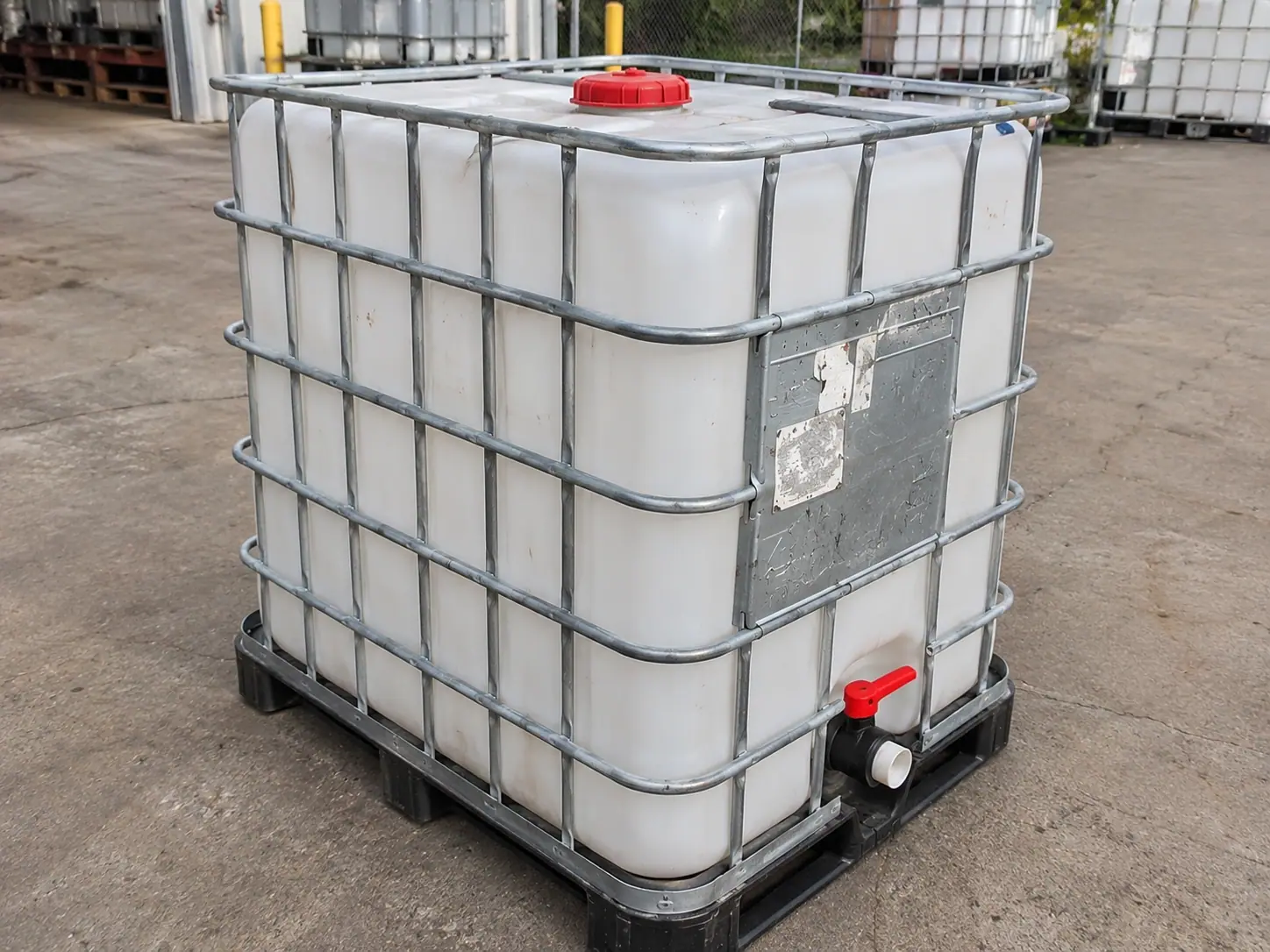 Fig. 1
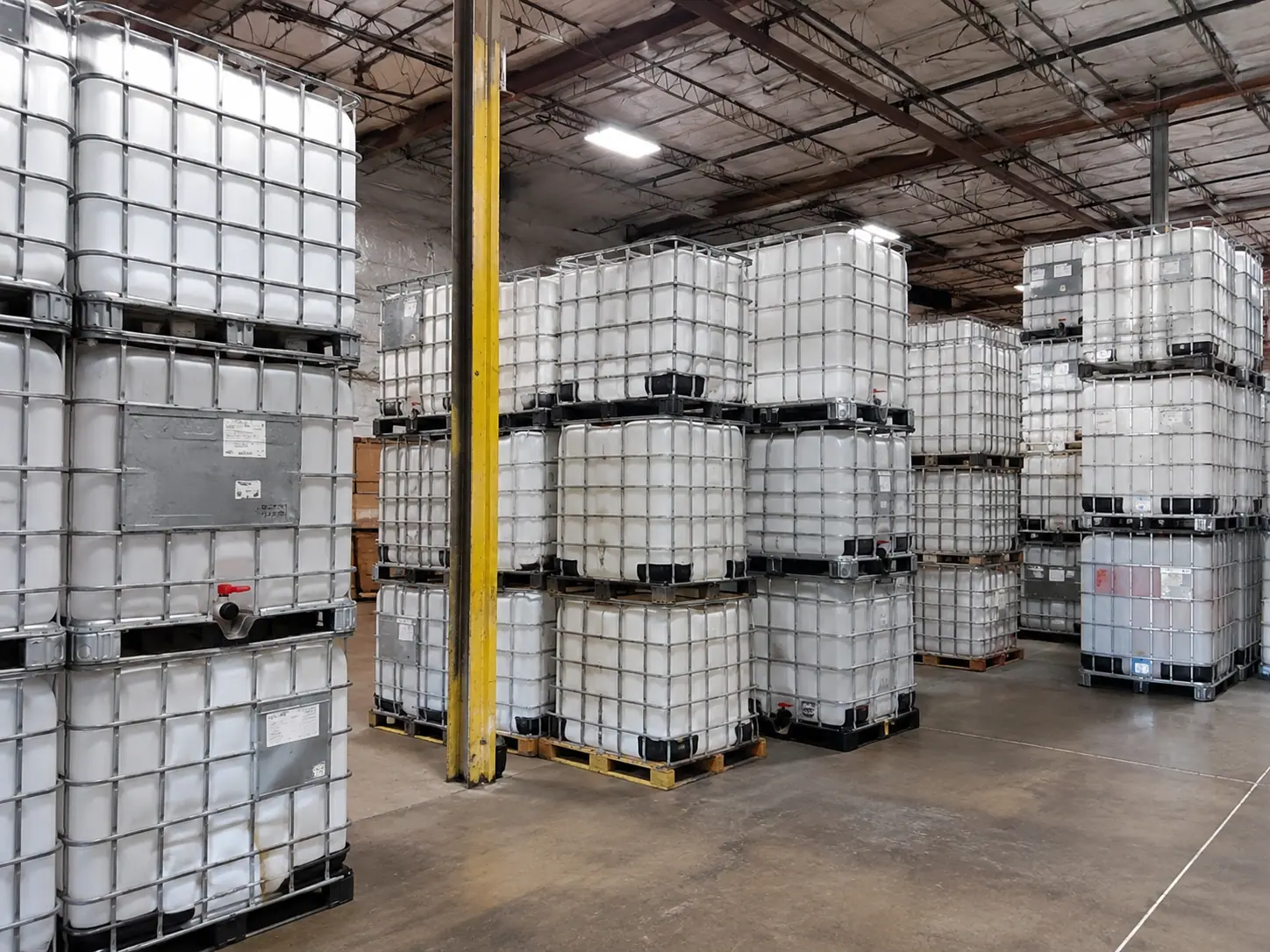 Fig. 2
| Capacity | Litres | Footprint | Height | Tare | Gross (water) | Stack loaded |
|---|---|---|---|---|---|---|
| 275 gal | 1,041 | 48 × 40 in | 46 in | ≈140 lb | ≈2,435 lb | 2 high |
| 330 gal | 1,249 | 48 × 40 in | 53 in | ≈155 lb | ≈2,905 lb | 2 high |
| 350 gal | 1,325 | 48 × 40 in | 56 in | ≈165 lb | ≈3,075 lb | 2 high |
| 120 gal | 454 | 40 × 32 in | 38 in | ≈95 lb | ≈1,095 lb | 2 high |
| 180 gal | 681 | 42 × 36 in | 42 in | ≈115 lb | ≈1,616 lb | 2 high |
| 550 gal | 2,082 | 60 × 48 in | 60 in | ≈240 lb | ≈4,830 lb | 1 high |
B / FITTINGS
What threads onto it
Fittings, threads and seat materials
| Fitting | Size | Seals by | Seat options | Typical service |
|---|---|---|---|---|
| S60x6 butterfly valve | 2 in | Flat gasket face | EPDM, Viton, PTFE | The standard IBC outlet |
| S70x6 butterfly valve | 2 in | Flat gasket face | EPDM, Viton | European and some 330 gal units |
| 2 in NPT ball valve, poly | 2 in | Thread flanks + tape | EPDM, Viton | Retrofits, metered dispensing |
| 2 in NPT ball valve, stainless | 2 in | Thread flanks + tape | PTFE | Solvents, pressure, hot cargo |
| 3 in butterfly valve | 3 in | Flat gasket face | EPDM, Viton | Viscous cargo, high flow |
| 6 in fill cap | 6 in | Gasketed lid | EPDM, silicone | Vented or solid — choose deliberately |
| Camlock adapter, type C | 1.5 / 2 in | Cam arms + gasket | Buna, Viton | Repeated connect / disconnect |
| Bulkhead tap | 3/4 in | Both-side gaskets | Brass, poly | Rain kits, site water |
| Material | Good with | Avoid with | Temperature | Cost |
|---|---|---|---|---|
| EPDM | Water, acids, caustics, brine, ag-chem | Oils, fuels, aromatics | -40 to 250 °F | Low |
| Viton (FKM) | Solvents, oils, fuels, aromatics | Ketones, amines, hot steam | -15 to 400 °F | High |
| Nitrile (NBR) | Oils, diesel, greases, hydraulics | Ozone, strong oxidisers | -30 to 250 °F | Low |
| PTFE envelope | Almost all chemistry, high purity | Needs very flat flange faces | -100 to 450 °F | High |
| Silicone | Food contact, wide temperature | Solvents, abrasion | -60 to 450 °F | Medium |
E / GRADING
A grade is a promise, not a mood
How every unit is scored
| # | Point | Critical? |
|---|---|---|
| 01 | Prior cargo declaration — present, written, specific | Yes |
| 02 | Residual liquid — any volume at all | Yes |
| 03 | Odour after wash — fixed odour by trained nose | Yes |
| 04 | Bottle corner stress whitening | No |
| 05 | Interior scoring you can feel | No |
| 06 | Interior crazing — fine surface cracking | Yes |
| 07 | Bottle bulge or deformation | Yes |
| 08 | Wall thickness at the thinnest point | Yes |
| 09 | Dome port condition and flange flatness | No |
| 10 | Outlet threads — cross-threading, chipping | Yes if crossed |
| 11 | Valve function, full open and close | No, replaceable |
| 12 | Gasket condition — compression set, bloom | No, replaceable |
| 13 | Cage squareness along the top rail | No, pressable |
| 14 | Cage weld integrity at tube intersections | Yes |
| 15 | Cage coating and galvanising loss | No |
| 16 | Pallet condition — cracked feet, rot, corrosion | No, replaceable |
| 17 | Forklift pocket integrity | No |
| 18 | UN marking legibility and date | No, re-markable |
| 19 | Leak test under our procedure | Yes |
D / ORDERING
Commercial terms, up front
Lead times, minimums and what happens when it goes wrong
| Item | Detail |
|---|---|
| Minimum order | One unit. No account minimum, no membership. |
| Stock lead time | Grade A and B 275 gal usually ship the same week |
| Rebottled lead time | 2–3 weeks, built to order in bay D |
| Food-grade lead time | 1–3 weeks when stock exists; supply-dependent |
| Full truckload | 45 on a 48 ft flat, 48 in a 53 ft van, 90 empties double-stacked |
| Payment, first order | Prepay by ACH or card |
| Payment, established | Net 30 on credit approval |
| Grade guarantee | Regrade or replace, our freight both ways, 14 days |
| Leak warranty | 30 days from delivery, normal atmospheric service |
| Cancellation | Free until the truck is loaded |
| Returns | 14 days on unused stock units, freight at your cost |
| Sales tax | Indiana resale certificates and out-of-state equivalents accepted |
G / PITFALLS
Learned the expensive way
Five mistakes that cost people money
Ordering a 330 without measuring the ceiling
A 275 and a 330 share a footprint; the 330 is seven inches taller. Two 330s stacked is 110 inches against 96 for two 275s, and most sprinkler regimes want eighteen inches of clearance below the deflector. That seven inches is frequently the whole margin.
Forcing an NPT fitting into an S60x6 port
Both are roughly two inches, so it bites and feels tight. It is not sealing, it is chewing the buttress thread. The joint weeps two days later, usually in transit, and cross-threading is one of the few faults that condemns an otherwise perfect bottle.
Reusing a flange gasket
A gasket is a one-use part the moment it has taken a compression set. Reusing one is the cause of most 'the new valve still leaks' emails we get. They cost a couple of dollars. Keep a box at the fill point.
Specifying a solid lid on a tote that sees sun
Sealed container, rising temperature, nowhere for the expansion to go. The bottle bulges between the cage bars and does not fully return. A vented lid is the cheapest risk control in this industry.
Ignoring specific gravity
A full 275 of water is 2,435 lb. The same tote of UAN 32 is 3,168 lb, and a 330 is 3,785 lb. Plenty of lift-gates are rated at 2,500 or 3,000 lb, and the rating assumes a centred load.
F / END OF LIFE
Reuse first, recycle last
What happens when the container is finally finished
| Step | Outcome | Share of mass | Cost to us |
|---|---|---|---|
| 01 | Reuse as is — wash and redeploy | 63.9% | 11 gal of mostly reclaimed water |
| 02 | Repair and reuse — valve, gasket, pallet, cage | 11.4% | Parts and bench time |
| 03 | Rebottle — new bottle, reclaimed steel | 9.6% | A new bottle, two thirds of mass retained |
| 04 | Upcycle — rain kits, grow beds, wash stations | 3.2% | Fabrication time |
| 05 | Material recovery — HDPE regrind, steel, wood | 11.3% | Grinding, washing, drying energy |
| 06 | Residual to licensed disposal | 0.6% | Sludge, gasket rubber, fasteners, laminates |
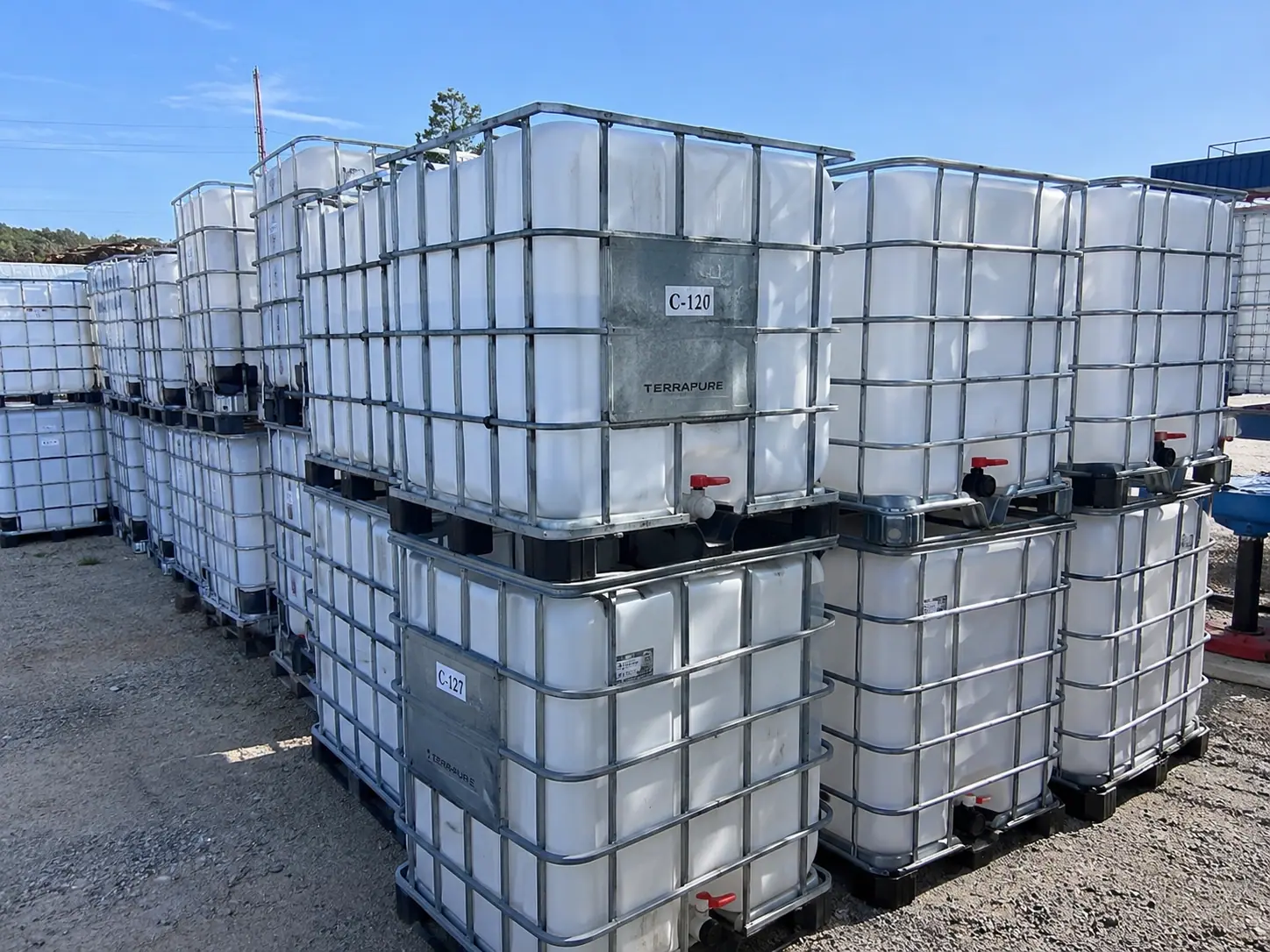
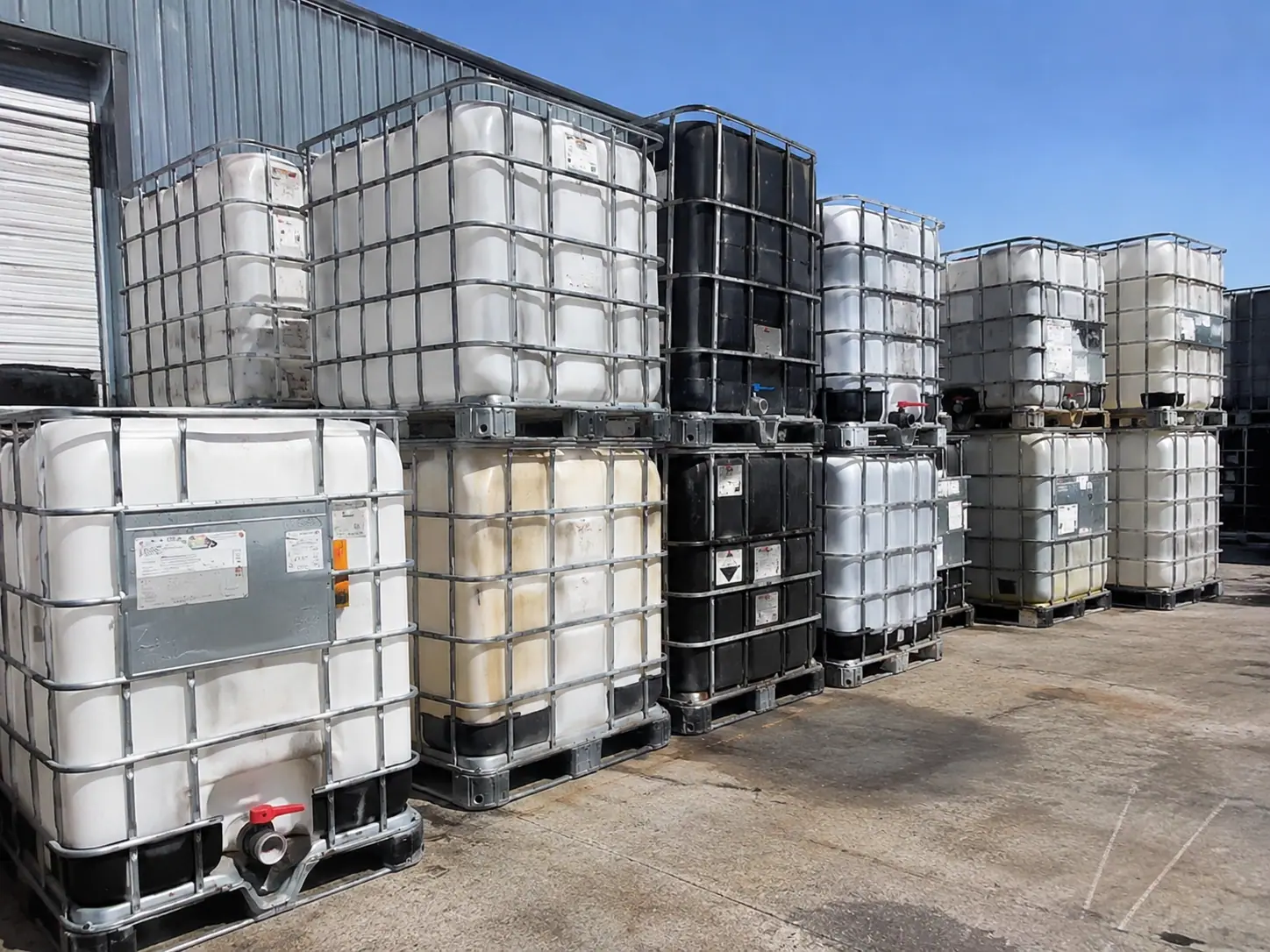
Toll washing