01 / HOW WE SERVE OREGON
Freight, grades and the return leg
Portland sits roughly 2,200 road miles from our dock, a 4 – 6 days lane. A long lane, so we quote full truckloads and consolidate buyback collections into the same trip.
Whatever ships into Oregon leaves here graded, leak-tested and documented — a written grade card and wash record per unit, and a valid UN marking where the cargo requires one. The grade you order is the grade that arrives; if it is not, the freight home is ours.
We also buy empties across Oregon. Dispatch pairs collections with outbound deliveries wherever geography allows, which is why pickups above twenty units are usually free rather than an add-on cost. Below that volume, batching into a larger collection two or three times a year is worth more per unit than calling us every month.
What tends to move here
The Oregon economy decides the mix. Across the state we see brewing, semiconductor, food, wood products, food processing, government — which in practice means a bias toward food-history units alongside general industrial Grade B.
Oregon at a glance
- RegionWest
- Hub cityPortland
- Road miles from yard2,200
- Delivery band4 – 6 days
- EquipmentPartner carrier, full truckload strongly preferred.
- ZIP prefixes970–979
- Buyback routingConsolidated batches
- Cities listed8
Clearing empties in Oregon?
Bring the written prior-cargo declaration and we can quote the same day. No declaration, no purchase — that rule applies in every state and it is the reason our outbound grades mean something.
02 / CITIES
8 cities
Where we deliver in Oregon
04 / STOCK & LEAD TIMES
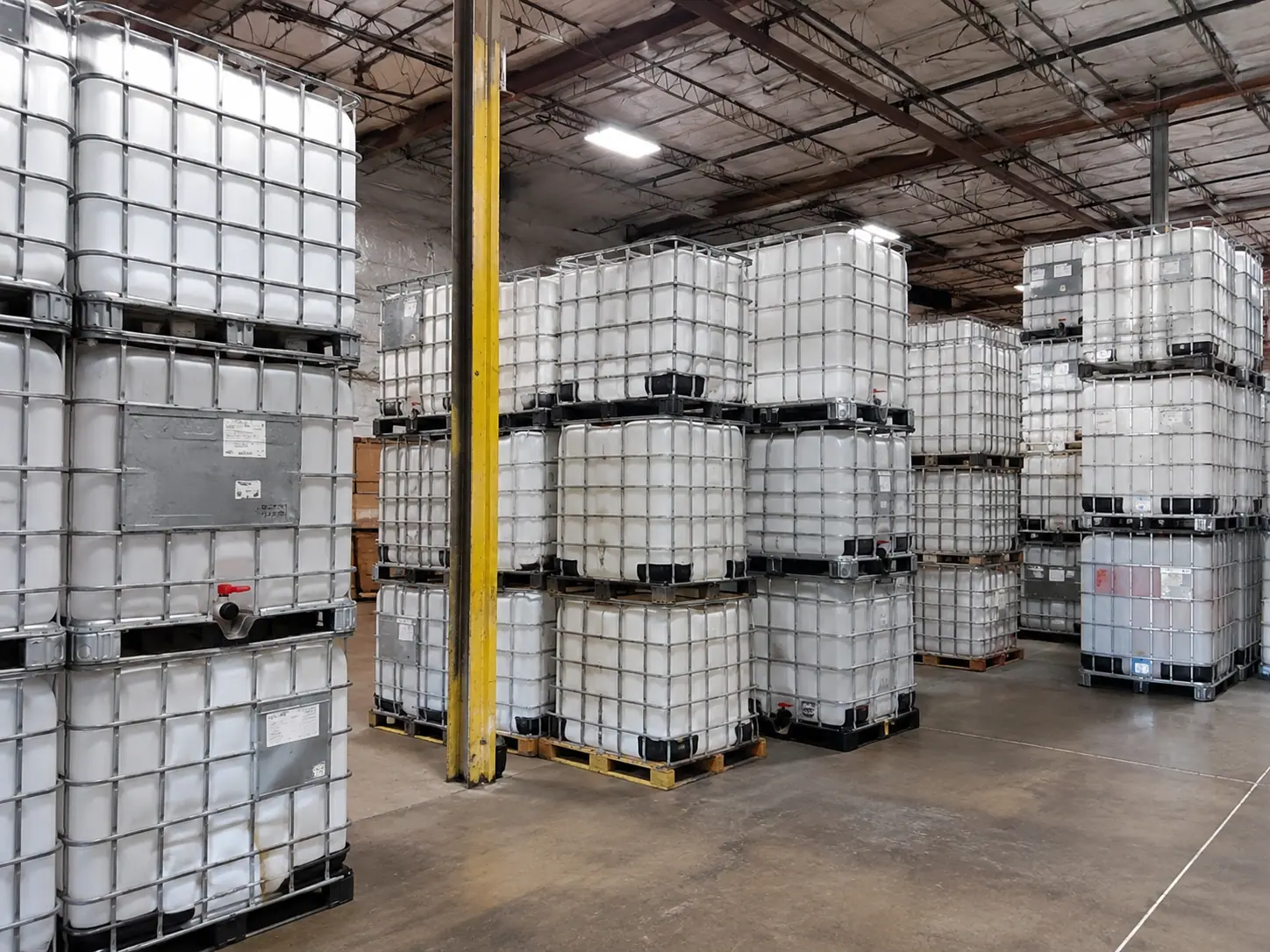
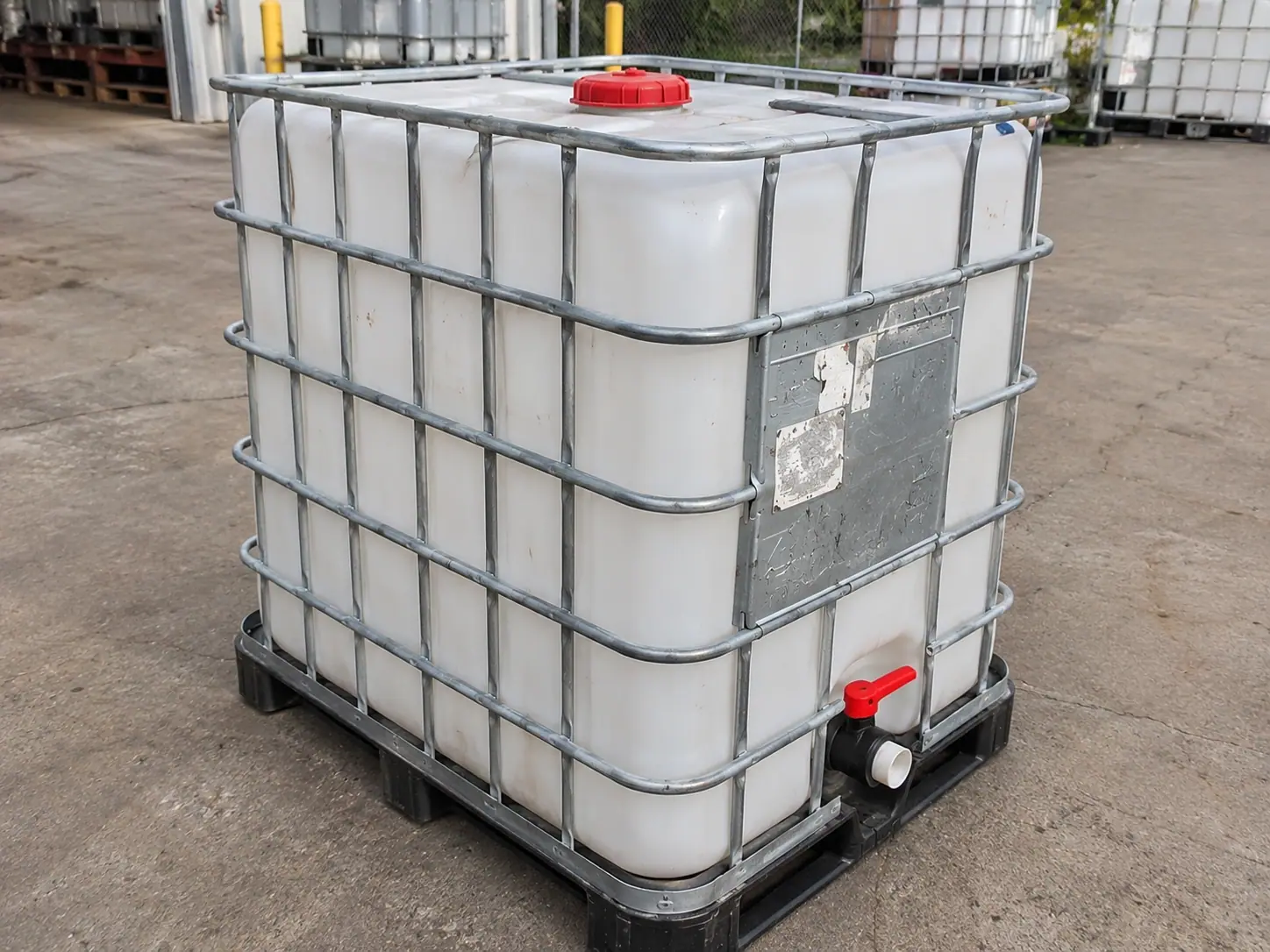
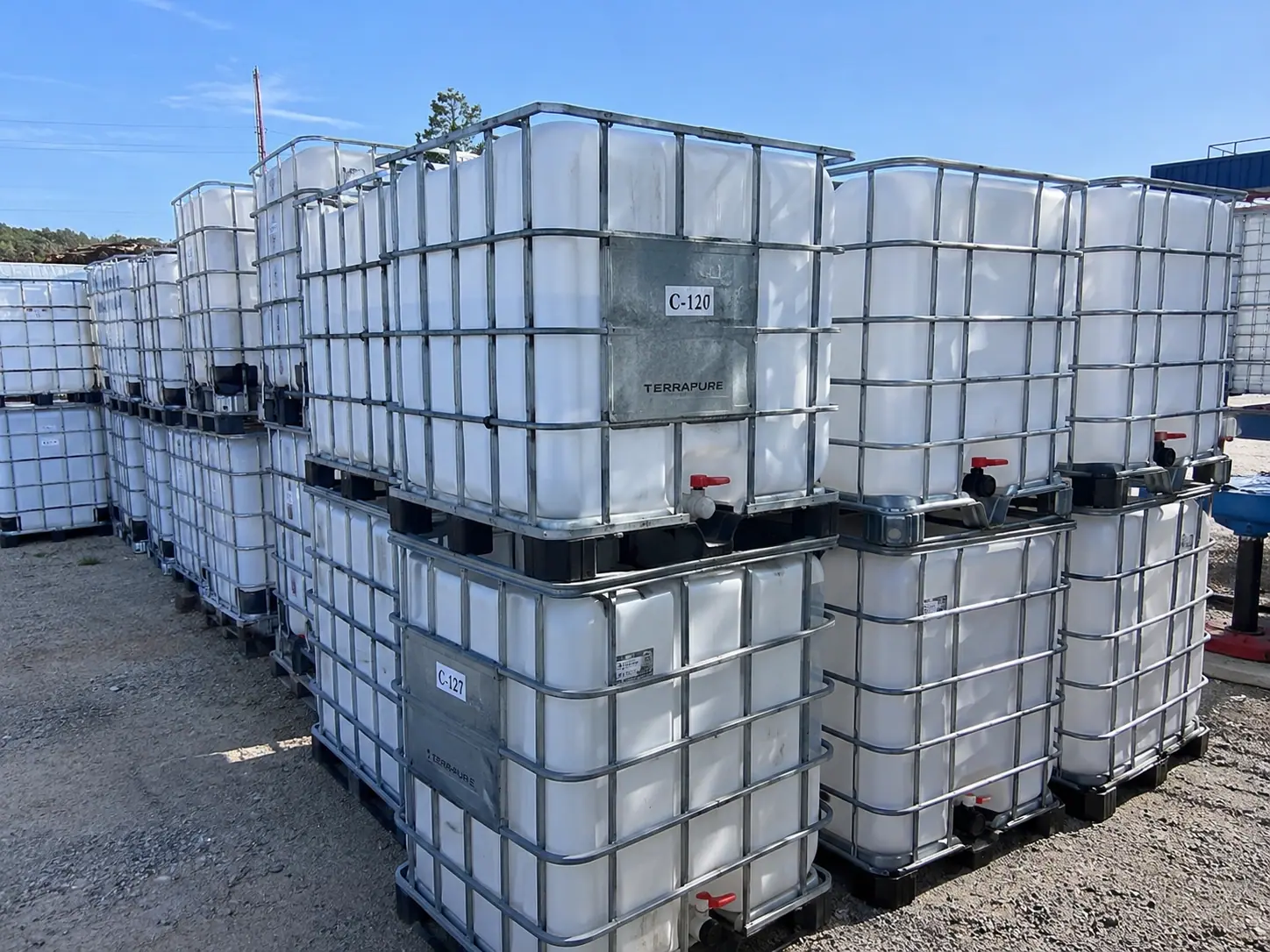
Everything we can put on a truck
What ships to Oregon
| Line | Capacity | Grades | Typical lead time | Notes |
|---|---|---|---|---|
| Reconditioned IBC totes | 275 / 330 gal | A, B, C | 4 – 6 days | 61% of everything we ship |
| Rebottled IBC totes | 275 / 330 gal | New bottle | 2–3 weeks + 4 – 6 days | New HDPE in a reclaimed cage |
| Food-grade totes | 275 gal | A, documented | 1–3 weeks, supply dependent | Standing list, lumpy supply |
| New IBC totes | 275 / 330 gal | New | 2–4 weeks | Sourced to order |
| Stainless IBCs | 119–793 gal | Refurbished | 3–6 weeks | 304 / 304L / 316 / 316L |
| Drums, poly & steel | 15 / 30 / 55 gal | Reconditioned | 4 – 6 days | Open and closed head |
| Accessories & parts | — | New | Same day before 1 PM ET | 190+ line items |
| Upcycled builds | — | Built to order | 1–3 weeks | Eleven standard patterns |
05 / FREIGHT
How it physically arrives
Getting a load into Oregon
| Equipment | Units | Needs a dock? | Transit | When we use it |
|---|---|---|---|---|
| 48 ft flatbed | 45 | Dock or forklift | 4 – 6 days | Full truckloads, the cheapest per unit |
| 53 ft dry van | 48 | Dock required | 4 – 6 days | Food-grade and sealed units |
| 48 ft flatbed, empties double-stacked | 90 | Dock or forklift | 4 – 6 days | Buyback collections |
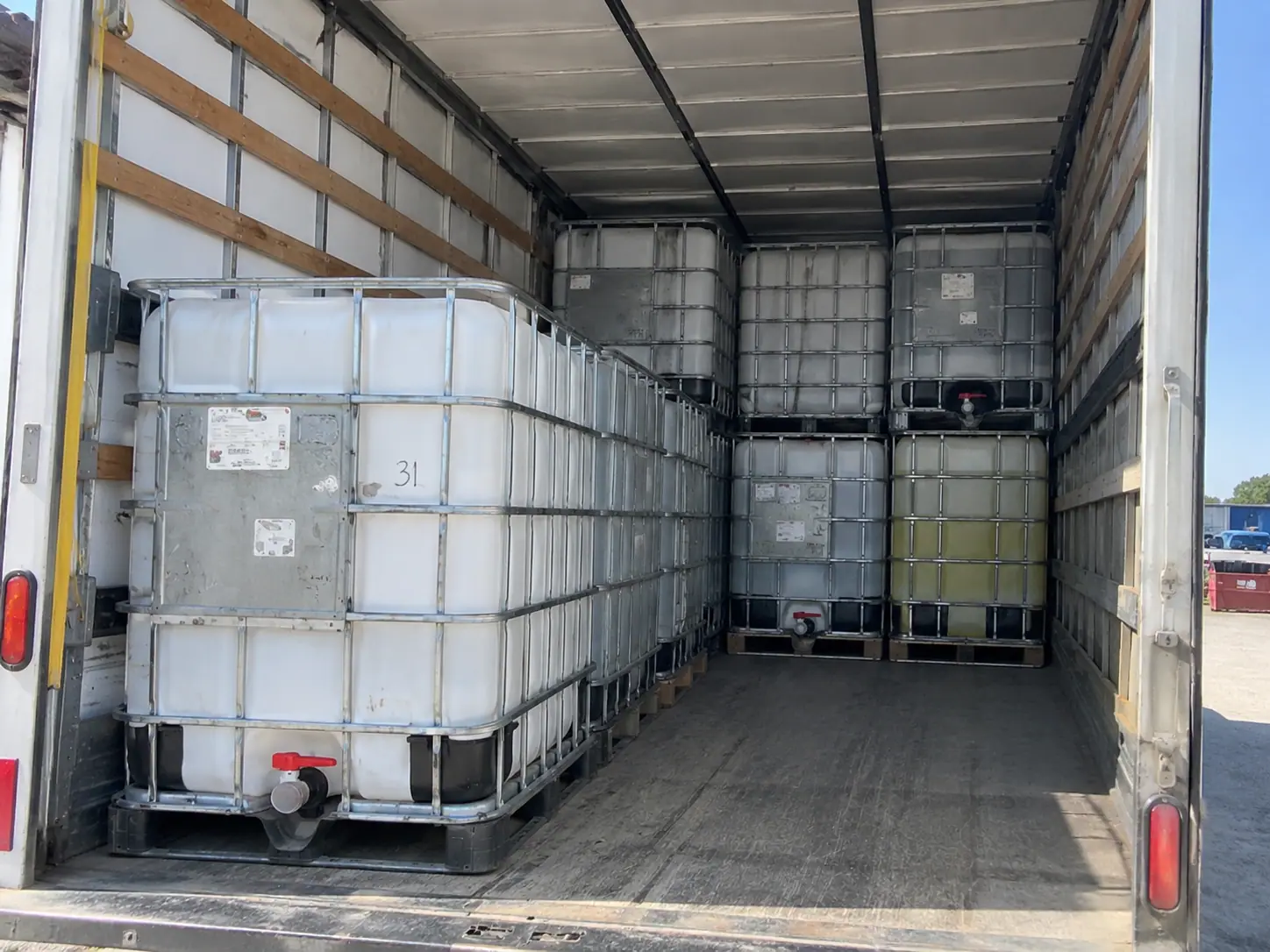
| 26 ft box truck, lift-gate | 16 | No | 4 – 6 days | Sites with no dock or forklift |
| Gooseneck hotshot | 12 | Forklift on site | Faster, regional | Partial loads and urgent runs |
| Your own carrier, FCA our yard | Your call | n/a | Your schedule | No handling fee, no markup |
If you have a dock
- Standard US dock height is 48 to 52 inches. Tell us if yours is not.
- Confirm your forklift capacity at load centre, not the headline rating.
- A 48 ft flatbed needs somewhere to turn around.
- Soft gravel in spring changes the equipment we send.
If you do not
- Box truck with a lift-gate, up to sixteen units.
- Check the lift-gate rating against the loaded weight of your cargo.
- A full tote of water is 2,435 lb; UAN 32 is 3,168 lb.
- Say so in the form and we quote it that way from the start.
06 / SPECIFICATION
Match the grade to the duty
Do not buy more container than the job needs
| Duty | Grade | Seat | Lid | Why |
|---|---|---|---|---|
| Liquid fertiliser, ag-chem | B | EPDM | Vented | Cosmetics have no value in a muddy field |
| Food, beverage, edible cargo | A, food history | Silicone / EPDM | Solid, sealed | History and documentation, not appearance |
| Industrial chemistry, regulated | A, re-marked | Viton / PTFE | Vented if fuming | A current UN marking is the deliverable |
| Solvents, oils, fuels | A or B | Viton | Vented | EPDM swells in oils |
| De-icer and brine | B or C | EPDM | Solid | Chloride is kind to HDPE, harsh on steel |
| Jobsite and non-potable water | C | EPDM | Vented | Sound, stained, cheapest thing we sell |
| Dust suppression, irrigation | C | EPDM | Vented | Grade C's natural home |
| Rain capture, planters, builds | C | Brass tap | Screened | Units that failed cargo grading |
| Glycol, CIP chemistry | B / C | EPDM | Vented for peracid | Dedicate the unit, never rotate |
07 / BUYBACK
We buy as well as sell
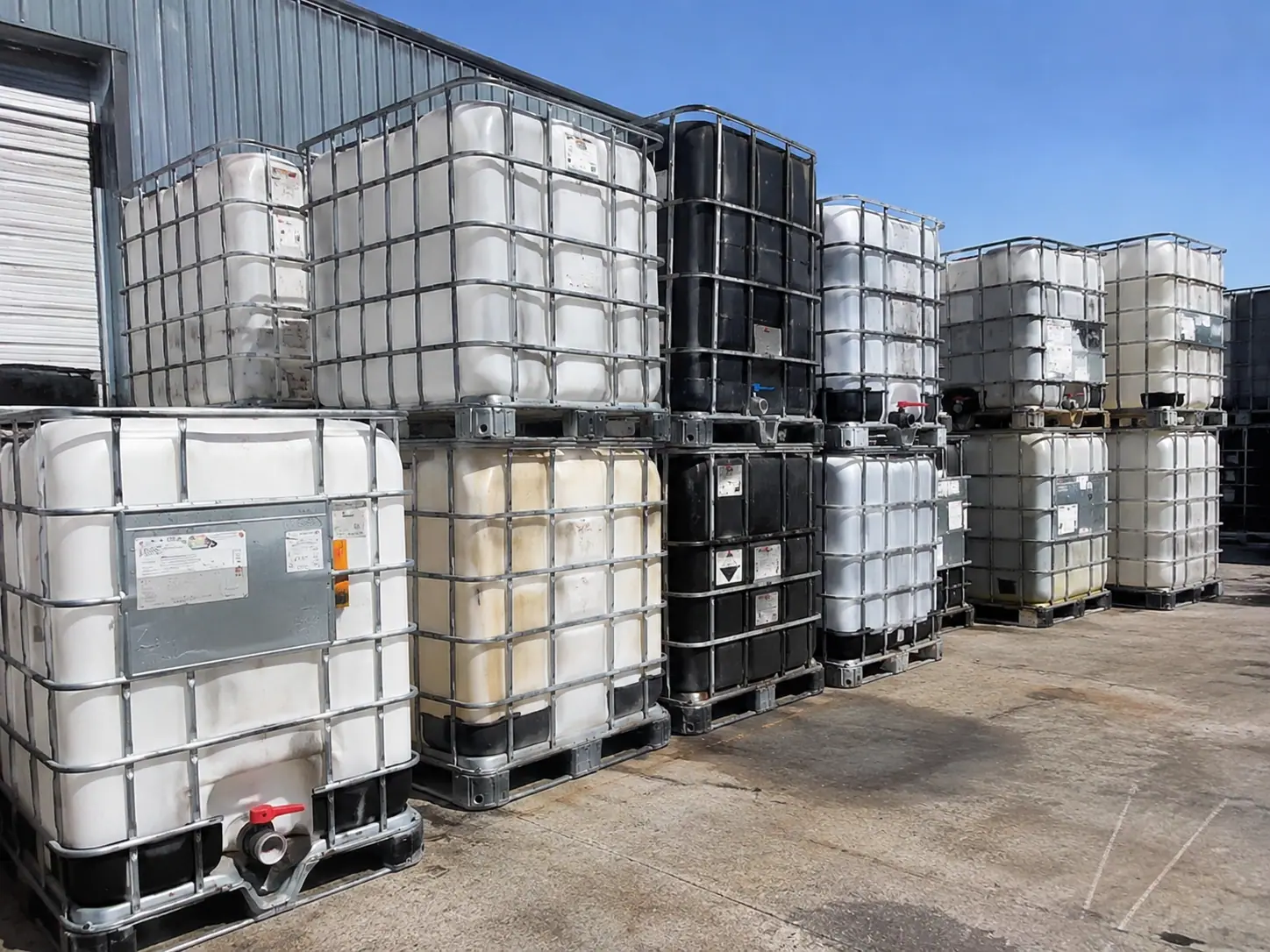
Clearing empties in Oregon
| Factor | Weight | What helps |
|---|---|---|
| Prior cargo | Largest | Documented food-only history can more than double unit value |
| Bottle condition | Second largest | Clear, unscored, no corner whitening |
| Cage geometry | Moderate | Bent is pressable; a cracked weld is a reject |
| Valve, lid and threads | Small but common | Cross-threaded ports are the usual hidden fault |
| Volume on one pickup | Moderate | Forty on one dock beats forty across five sites |
| Distance from Indianapolis | Moderate | Sitting on an existing lane is worth real money |
| Timing flexibility | Small | A two-week window beats a fixed Tuesday |
| Documentation quality | Pass or fail | No written declaration, no purchase. No exceptions. |
What we buy
- 275 and 330 gallon caged composite totes, any grade
- Food-history single-trip units — our highest-value input
- Stainless IBCs in any condition
- 55, 30 and 15 gallon poly and steel drums by the pallet
- Cages and pallets with no bottle at all
- Damaged units for resin recovery, at scrap value
What we cannot take
- Anything without a written prior-cargo declaration
- Cargo meeting the RCRA hazardous waste criteria
- Containers with residual liquid of any volume
- Units that held essential oils or flavour concentrates
- Unreadable UN markings with unknown history
Before the truck comes
- Drain completely. Residual liquid gets a load refused.
- Cap the valve and the six-inch lid.
- Consolidate onto one dock if you can.
- Find the cargo paperwork first — it is worth more than a wash.
- Stage somewhere a forklift can reach.
08 / DOCUMENTATION
Paperwork is part of the product
What arrives with the load
| Document | Scope | What it proves |
|---|---|---|
| Grade card | Per unit | Nineteen inspection points, inspector initials, date, grade |
| Wash record | Per unit | Cargo class, chemistry, temperature, dwell, rinse, operator |
| Prior-cargo declaration | Per unit | Everything the container has ever held, verbatim |
| Leak test result | Per re-marked unit | Pass value and method under 49 CFR 178.801 |
| Chain-of-custody letter | On request | Where the container came from and where it went |
| Diversion certificate | Quarterly, on request | Mass diverted and emissions avoided, on letterhead |
09 / QUESTIONS
Asked most often in this market
Ten answers before you email
How quickly can you deliver to Oregon?
4 – 6 days from release on stock grades — reconditioned Grade A and B 275 gallon units are the fastest moving line we have. Rebottled units are a two to three week build regardless of distance, and food-grade depends entirely on what has been released to us that month. A long lane, so we quote full truckloads and consolidate buyback collections into the same trip.
What is the minimum order?
One unit. There is no account minimum, no membership and no quarterly commitment. That said, below about six units the freight is the decision rather than the container — so grouping with another buyer nearby, or taking a larger delivery less often, usually beats repeated small shipments.
Do you collect empties in Oregon?
Yes. We consolidate collections across the region rather than running dedicated trips, so tell us your annual volume and we will schedule around our existing lanes. Every purchase needs a written prior-cargo declaration — that rule applies in every state and it is the reason our outbound grades mean anything.
Which grade should I order?
Usually Grade B: structurally sound, leak-tested, cosmetically unremarkable, and our best value by a wide margin. Grade A when appearance or re-marking headroom matters; Grade C for non-potable water only. The full nineteen-point scoring system and the exact thresholds that move a unit between grades are on the grade scale page.
What if my site has no loading dock?
We send a 26 foot box truck with a lift-gate, up to sixteen units. It costs more per unit than a flatbed and it is the only arrangement that reliably works without a dock or a forklift. Check the gate rating against your loaded weight — a full 275 gallon tote of water is 2,435 lb, and the same tote of UAN 32 is 3,168 lb.
Can you supply food-grade units here?
Yes, when we have them. Food-grade supply depends on what food plants release to us, so it is lumpy by nature — we cannot manufacture a container's history. Tell us the volume and the month and we will put you on the standing list rather than quote you a comfortable date. The three conditions are set out on the food-grade page.
Do your units carry a valid UN marking?
Where the cargo requires one, yes — re-marked to UN 31HA1/Y after leak and, where the design type requires it, hydrostatic testing under 49 CFR 178.801. Roughly six per cent of units entering the test cell fail, almost always at a gasket rather than the bottle wall, and those get a new gasket and a retest rather than a quiet downgrade. Send us your existing marking and we will decode it free.
What happens if the grade is wrong on arrival?
Email a photograph within fourteen days. We credit the difference or collect and replace the unit, and we pay freight in both directions. No form, no restocking charge, no argument — the fault is ours. Reconditioned and rebottled units also carry a thirty-day leak warranty under normal atmospheric service with compatible cargo.
Can I visit the yard instead?
It is roughly 2,200 miles each way, so freight is almost certainly cheaper. Customers who do make the drive are usually combining it with something else — and walkthroughs run Tuesday and Thursday mornings if you want to see the line.
How do I pay?
First order is prepaid by ACH or card; Net 30 on credit approval after that. Buyback payments to you are Net 10 by ACH, or cash on the spot for units delivered to our yard. Indiana resale certificates and out-of-state equivalents are accepted.
Oregon pricing